- Data input
- Data output
- Data summary
- Summarizing data with figures
Agenda
Getting data into R
Importing data into R is fairly simple. We can use built-in functions or libraries to read data from the following sources:
- Text file (.txt)
- Comma-separated values (.csv)
- Excel (.xlsx or .xls)
- Database table
Common data formatting
Regardless the sources, there are common characteristics about how data are formatted
- There are usually multiple columns
- There is a clear way to separate columns
- comma (
,), semicolon (;), vertical bar (|), tab (\t), etc.
- comma (
- The first line often contains the names of the columns
Example data files
You can go to Canvas - Sample Dataset Module to download the following data, or click on the following links.
Note 1: If your browser opens the file directly (rather than downloading the file), you can still download/save it by entering
ctrlandstogether.Note 2: Some of your data may contain missing values. Here is an example:
Working directory
Your working directory is the folder on your computer in which you are currently working.
# Show your current working directory
getwd()

# List the files and folders in the current working directory
list.files()

# Set your working directory; make sure the directory exist!!
setwd("/Users/sophiazhang/Dropbox (Personal)/Teaching/BI-2023-Spring/BI_2023Spring") #NOTE: / (forward slash) instead of \ (backward slash)
How to find a file’s (or a folder’s) path
- On Windows PC:
- On Mac:
Creating an RStudio Project
An RStudio Project points to a directory for a project and uses that directory as your default working directory
If you are in a Project, you do not need to run
setwd(...)whenever you restart your RStudio
Let’s create a project for this course
Step 1: Create a folder BI-Spring2023 on your computer. Remember where it is. For example, if you are using a Windows PC, you can put the folder under C:\BI-Spring2023.

Let’s create a project for this course
Step 2: Click the Project icon on the top right corner of RStudio and choose New Project
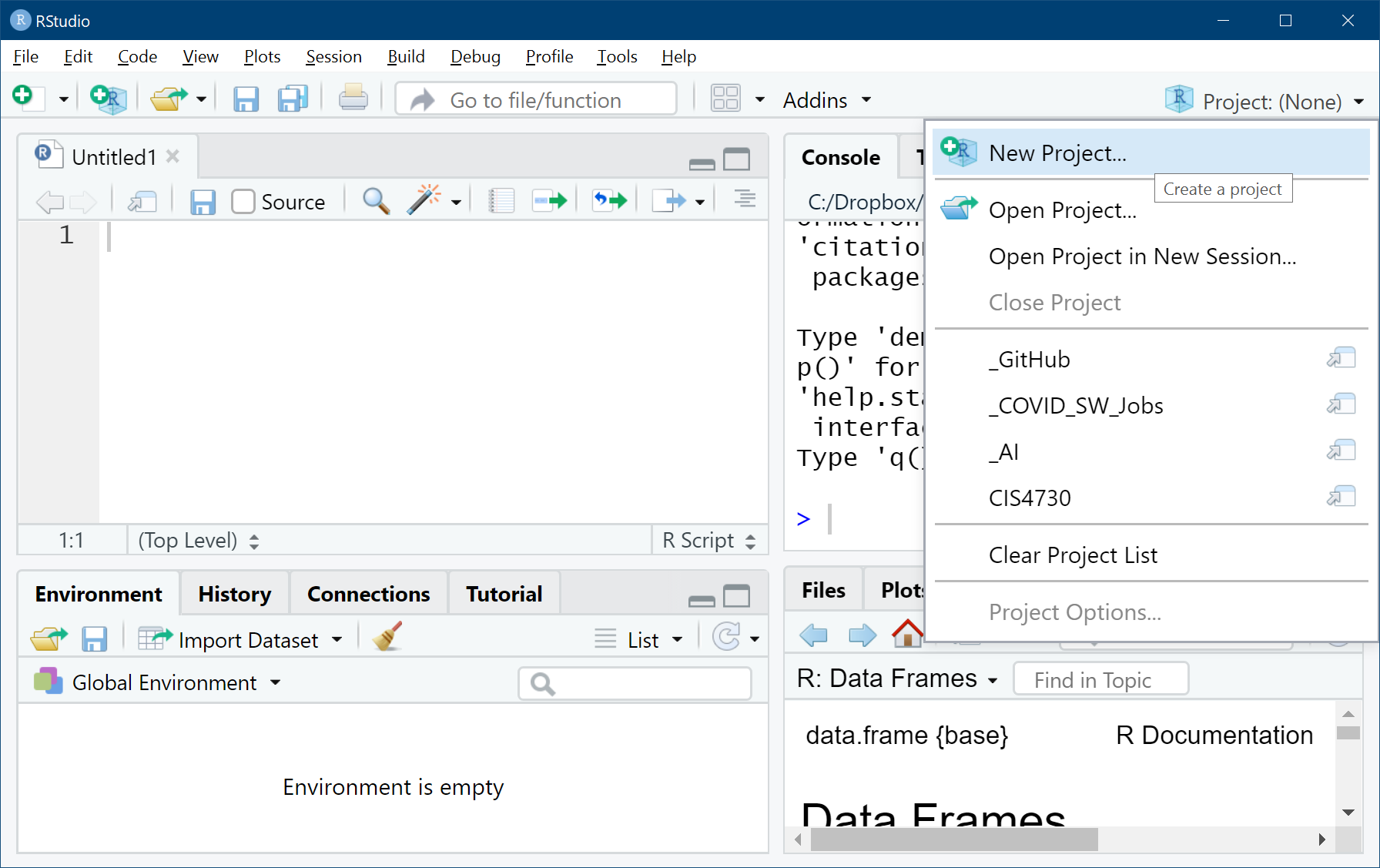
Let’s create a project for this course
Step 3: Choose to use an existing directory
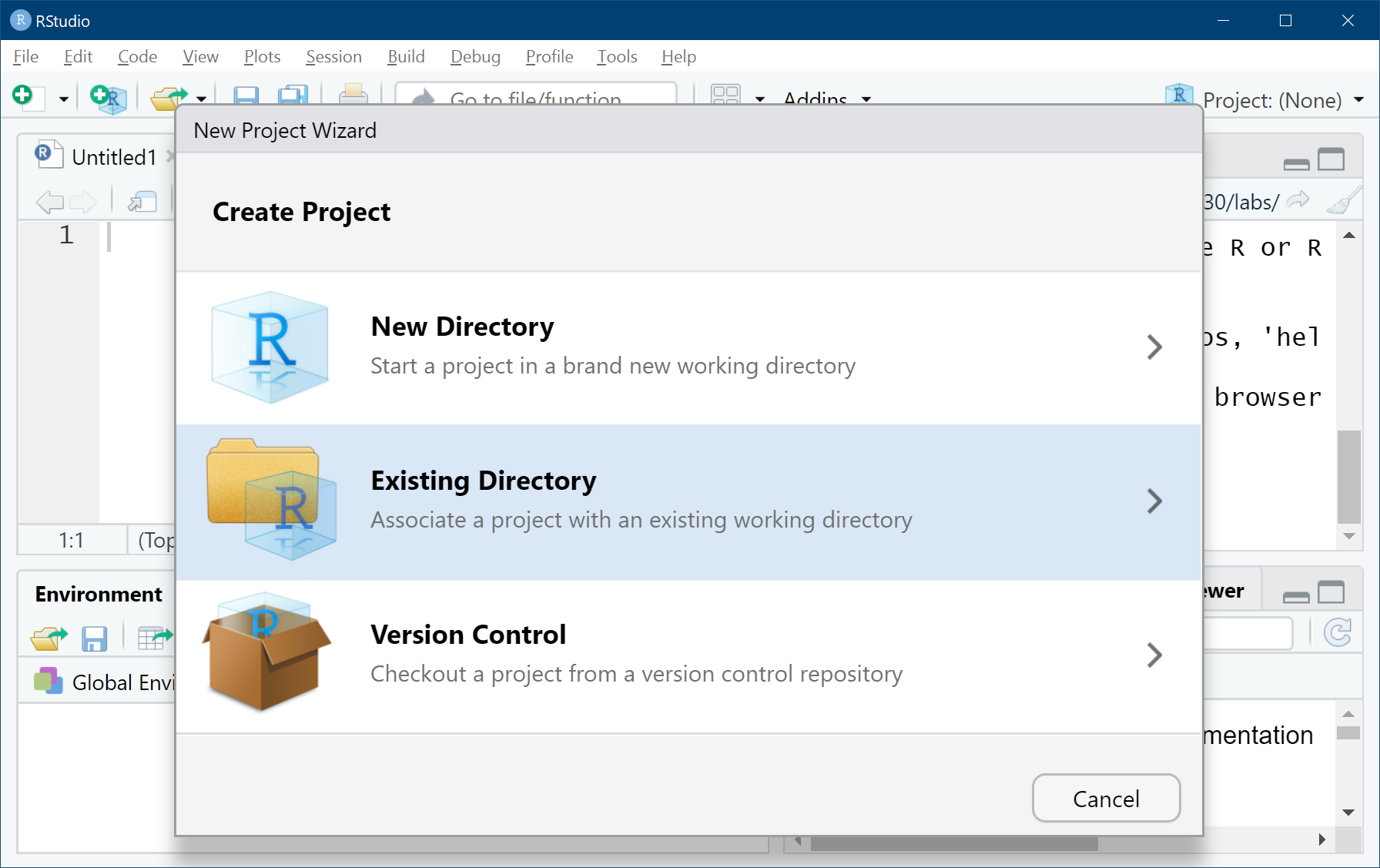
Let’s create a project for this course
Step 4: Click Browse to navigate to the directory you just created in Step 1 and then click the Create Project button

Let’s create a project for this course
Step 5: Done! You can now put all the data files into that project directory and they are accessible via “relative path” (more on this later).
Your turn
Following the steps to create a project in RStudio
Download all data files on slide #5 and move them into the project folder
Run
list.files()in the R console. Do you see these files?
Important: From this point forward and throughout the rest of the semester, I will assume that you are in the BI-Spring2023 project when you are developing R code in RStudio.
Read text file
You need to specify the path to the text file.
Read file through an absolute path.
Analogy: Suppose someone asks you how to get to the instructor’s office. You can say:
  The Foster Building for Business and Innovation, Room 310.36
  1621 S 3rd St
  Waco, TX 76706
df<-read.table(file="/Users/sophiazhang/Dropbox (Personal)/Teaching/BI-2023-Spring/Sample Dataset/CSV/HousePrices.csv",
               sep=",", header=TRUE, stringsAsFactors=FALSE)

class(df) # R will convert the file to a data frame
## [1] "data.frame"
What the data looks like?
head() is a function allows you to see the top few rows of the data frame
head(df, n=5) # n indicates how many rows you'd like to see
##   price lotsize bedrooms bathrooms stories driveway recreation fullbase gasheat
## 1 42000    5850        3         1       2      yes         no      yes      no
## 2 38500    4000        2         1       1      yes         no       no      no
## 3 49500    3060        3         1       1      yes         no       no      no
## 4 60500    6650        3         1       2      yes        yes       no      no
## 5 61000    6360        2         1       1      yes         no       no      no
##   aircon garage prefer
## 1     no      1     no
## 2     no      0     no
## 3     no      0     no
## 4     no      0     no
## 5     no      0     no
Read file through a relative path (relative to the working directory):
Continue with our previous analogy: Suppose you are inside the Foster Business School building and someone asks you how to get to the instructor’s office, you can just say:
Room 310.36
df <- read.table(file="HousePrices.csv", sep=",",
                 header=TRUE, stringsAsFactors=FALSE)
- Important: If you are not in a RStudio Project, always make sure that you are using the right working directory (
getwd()andsetwd()) before you try to access a file.
Because csv files are very common, there is another function in R that makes it easier to read csv files:
df3 <- read.csv(file="HousePrices.csv", header=TRUE,
                stringsAsFactors=FALSE)
head(df, n=4)
##   X  price lot_size waterfront age land_value construction air_cond     fuel
## 1 1 132500     0.09         No  42      50000           No       No Electric
## 2 2 181115     0.92         No   0      22300           No       No      Gas
## 3 3 109000     0.19         No 133       7300           No       No      Gas
## 4 4 155000     0.41         No  13      18700           No       No      Gas
##        heat   sewer living_area fireplaces bathrooms rooms
## 1  Electric Private         906          1       1.0     5
## 2 Hot Water Private        1953          0       2.5     6
## 3 Hot Water  Public        1944          1       1.0     8
## 4   Hot Air Private        1944          1       1.5     5
Read other text files
The key is to specify the correct column separator character. When there is missing values in your data, you need to tell R how to recognize these missing values.
df_semicolon <- read.table(file="HousePrices_semicolon.txt", sep=";",
                           header=TRUE, stringsAsFactors=FALSE)

df_tab <- read.table(file="HousePrices_tab.txt", sep="\t",
                     header=TRUE, stringsAsFactors=FALSE)

df_csv_na <- read.table(file="HousePrices_with_missing_values.csv", sep=",",
                    header=TRUE, stringsAsFactors=FALSE,
                    na.strings = c("","NA", "Not Available"))
Parameters in read.table() & read.csv()
sep
- specify the character/string that seperates columns
stringsAsFactors
- logical: should character vectors be converted to factors? Usually, set to
FALSE.
na.strings
- a vector of strings which are to be interpreted as NA values.
Your turn
Try if you can read HousePrices_semicolon.txt, HousePrices_tab.txt, HousePrices_with_missing_values.csv into R, and save them to different data frames df_semicolon, df_tab, and df_csv_na.
You can then verify if you have these data in R by typing:
head(df_semicolon)
head(df_tab)
head(df_csv_na)
Read data from the Internet
url <- "https://stats.idre.ucla.edu/wp-content/uploads/2016/02/test-1.csv"
df <- read.csv(file=url, header=TRUE,
               stringsAsFactors=FALSE)
head(df)
##    make   model mpg weight price
## 1   amc concord  22   2930  4099
## 2   amc   oacer  17   3350  4749
## 3   amc  spirit  22   2640  3799
## 4 buick century  20   3250  4816
## 5 buick electra  15   4080  7827
Read Excel file
To read Excel data, we need to use a library: readxl
First, you need to install the package on your computer.
install.packages("readxl") # R will then go online and donwload the libray
library("readxl") # You need to load the library into R before you can use it.
df <- read_excel("HousePrices.xlsx", col_names = TRUE)
head(df, n=3)
## # A tibble: 3 × 15 ## ...1 price lot_size waterf…¹ age land_…² const…³ air_c…⁴ fuel heat sewer ## <dbl> <dbl> <dbl> <chr> <dbl> <dbl> <chr> <chr> <chr> <chr> <chr> ## 1 1 132500 0.09 No 42 50000 No No Elec… Elec… Priv… ## 2 2 181115 0.92 No 0 22300 No No Gas Hot … Priv… ## 3 3 109000 0.19 No 133 7300 No No Gas Hot … Publ… ## # … with 4 more variables: living_area <dbl>, fireplaces <dbl>, ## # bathrooms <dbl>, rooms <dbl>, and abbreviated variable names ¹waterfront, ## # ²land_value, ³construction, ⁴air_cond
Read data from database
The
RODBCpackage provides access to Microsoft Access and Microsoft SQL ServerThe
RMySQLpackage provides an interface to MySQL.The
ROraclepackage provides an interface for Oracle.
You just need to install these libraries and follow their reference manuals.
install.packages("RODBC")
install.packages("RMySQL")
install.packages("ROracle")
Write data to a file
file_path <- "my_test.csv"
write.csv(df, file=file_path, row.names = FALSE)
# row.names are usually not very useful. So I like to exclude them.

file_path <- "my_test2.csv"
write.table(df, file_path, sep=",", row.names = FALSE)

file_path <- "my_test_semicolon.txt"
write.table(df, file_path, sep=";", row.names = FALSE)

file_path <- "my_test_tab.txt"
write.table(df, file_path, sep="\t", row.names = FALSE)
Data summary: str()
str(df)
## tibble [1,728 × 15] (S3: tbl_df/tbl/data.frame)
##  $ ...1        : num [1:1728] 1 2 3 4 5 6 7 8 9 10 ...
##  $ price       : num [1:1728] 132500 181115 109000 155000 86060 ...
##  $ lot_size    : num [1:1728] 0.09 0.92 0.19 0.41 0.11 0.68 0.4 1.21 0.83 1.94 ...
##  $ waterfront  : chr [1:1728] "No" "No" "No" "No" ...
##  $ age         : num [1:1728] 42 0 133 13 0 31 33 23 36 4 ...
##  $ land_value  : num [1:1728] 50000 22300 7300 18700 15000 14000 23300 14600 22200 21200 ...
##  $ construction: chr [1:1728] "No" "No" "No" "No" ...
##  $ air_cond    : chr [1:1728] "No" "No" "No" "No" ...
##  $ fuel        : chr [1:1728] "Electric" "Gas" "Gas" "Gas" ...
##  $ heat        : chr [1:1728] "Electric" "Hot Water" "Hot Water" "Hot Air" ...
##  $ sewer       : chr [1:1728] "Private" "Private" "Public" "Private" ...
##  $ living_area : num [1:1728] 906 1953 1944 1944 840 ...
##  $ fireplaces  : num [1:1728] 1 0 1 1 0 1 1 1 0 0 ...
##  $ bathrooms   : num [1:1728] 1 2.5 1 1.5 1 1 1.5 1.5 1.5 1.5 ...
##  $ rooms       : num [1:1728] 5 6 8 5 3 8 8 9 8 6 ...
Data summary: summary()
summary(df)
##       ...1            price           lot_size        waterfront
##  Min.   :   1.0   Min.   :  5000   Min.   : 0.0000   Length:1728
##  1st Qu.: 432.8   1st Qu.:145000   1st Qu.: 0.1700   Class :character
##  Median : 864.5   Median :189900   Median : 0.3700   Mode  :character
##  Mean   : 864.5   Mean   :211967   Mean   : 0.5002
##  3rd Qu.:1296.2   3rd Qu.:259000   3rd Qu.: 0.5400
##  Max.   :1728.0   Max.   :775000   Max.   :12.2000
##       age           land_value     construction         air_cond
##  Min.   :  0.00   Min.   :   200   Length:1728        Length:1728
##  1st Qu.: 13.00   1st Qu.: 15100   Class :character   Class :character
##  Median : 19.00   Median : 25000   Mode  :character   Mode  :character
##  Mean   : 27.92   Mean   : 34557
##  3rd Qu.: 34.00   3rd Qu.: 40200
##  Max.   :225.00   Max.   :412600
##      fuel               heat              sewer            living_area
##  Length:1728        Length:1728        Length:1728        Min.   : 616
##  Class :character   Class :character   Class :character   1st Qu.:1300
##  Mode  :character   Mode  :character   Mode  :character   Median :1634
##                                                           Mean   :1755
##                                                           3rd Qu.:2138
##                                                           Max.   :5228
##    fireplaces       bathrooms       rooms
##  Min.   :0.0000   Min.   :0.0   Min.   : 2.000
##  1st Qu.:0.0000   1st Qu.:1.5   1st Qu.: 5.000
##  Median :1.0000   Median :2.0   Median : 7.000
##  Mean   :0.6019   Mean   :1.9   Mean   : 7.042
##  3rd Qu.:1.0000   3rd Qu.:2.5   3rd Qu.: 8.250
##  Max.   :4.0000   Max.   :4.5   Max.   :12.000
First few rows of data
head(df, n=2)
## # A tibble: 2 × 15 ## ...1 price lot_size waterf…¹ age land_…² const…³ air_c…⁴ fuel heat sewer ## <dbl> <dbl> <dbl> <chr> <dbl> <dbl> <chr> <chr> <chr> <chr> <chr> ## 1 1 132500 0.09 No 42 50000 No No Elec… Elec… Priv… ## 2 2 181115 0.92 No 0 22300 No No Gas Hot … Priv… ## # … with 4 more variables: living_area <dbl>, fireplaces <dbl>, ## # bathrooms <dbl>, rooms <dbl>, and abbreviated variable names ¹waterfront, ## # ²land_value, ³construction, ⁴air_cond
df[1:2,] # df[ rows_you_want, columns_you_want ]
## # A tibble: 2 × 15 ## ...1 price lot_size waterf…¹ age land_…² const…³ air_c…⁴ fuel heat sewer ## <dbl> <dbl> <dbl> <chr> <dbl> <dbl> <chr> <chr> <chr> <chr> <chr> ## 1 1 132500 0.09 No 42 50000 No No Elec… Elec… Priv… ## 2 2 181115 0.92 No 0 22300 No No Gas Hot … Priv… ## # … with 4 more variables: living_area <dbl>, fireplaces <dbl>, ## # bathrooms <dbl>, rooms <dbl>, and abbreviated variable names ¹waterfront, ## # ²land_value, ³construction, ⁴air_cond
Last few rows of data
tail(df, n=2)
## # A tibble: 2 × 15 ## ...1 price lot_size waterf…¹ age land_…² const…³ air_c…⁴ fuel heat sewer ## <dbl> <dbl> <dbl> <chr> <dbl> <dbl> <chr> <chr> <chr> <chr> <chr> ## 1 1727 125000 0.24 No 48 16800 No No Gas Hot … Publ… ## 2 1728 111300 0.59 No 86 26000 No No Gas Hot … Priv… ## # … with 4 more variables: living_area <dbl>, fireplaces <dbl>, ## # bathrooms <dbl>, rooms <dbl>, and abbreviated variable names ¹waterfront, ## # ²land_value, ³construction, ⁴air_cond
Summarizing data with figures
- Histogram
- Bar plot
- Pie chart
- Scatter plot
Histogram of a numeric variable
Histogram takes a numeric vector as input, and creates bins to visualize the distribution of numbers in the vector.
hist(df$price)

hist(df$price, breaks=20) # adjust the size of each bin via breaks
# to learn more about these additional arguments, just type ?hist
hist(df$price, col="green", xlim=c(50000, 150000),
     xlab="Price of house", ylab="Count",
     main="Distribution of house price")

Your turn
Create the following graph

Frequency of a categorical variable
table(df$air_cond)
##
##   No  Yes
## 1093  635
table(df$heat)
##
##  Electric   Hot Air Hot Water
##       305      1121       302
table(df$fuel)
##
## Electric      Gas      Oil
##      315     1197      216
Bar plot
In a bar plot, the x axis is for categorical values while in a histogram, the x axis is for numerical values.
ditribution <- table(df$heat)
ditribution
##
##  Electric   Hot Air Hot Water
##       305      1121       302
barplot(ditribution)

Pie chart for a string/factor variable
ditribution <- table(df$fuel)
pie(ditribution)

You turn
Show a histogram of
lot_sizeShow a bar plot of
air_condShow a pie chart of
construction
Detour: formula
The template for a formula in R is as follows:
outcome ~ predictor_1 + predictor_2 + ...
A formula usually has two parts: 1) one outcome variable on the left and 2) a set of predictors on the right
The two parts are separated by a tilde sign (
~)Formulas are frequently used in regression analyses and data mining. But you can also use formulas in some basic graphics.
Essentially, you use a formula to tell R that you are interested in the relationship between the outcome variable and the predictors
Scatter plot
plot(price ~ lot_size, data=df) # y_axis ~ x_axis

ifelse()
ifelse(condition, do_this_if_true, do_this_if_false)
ifelse()is a function. Do not confuse it withif( ){...}else{...}, although they achieve the same thing.
Example:
a <- 2; b <- 1
ifelse(a > b, "a is greater than b", "a is less than b")
## [1] "a is greater than b"
color <- ifelse(a==b, "red", "blue")
print(color)
## [1] "blue"
Make plots prettier & more informative
plot(price ~ lot_size, data=df,
     pch=ifelse(df$air_cond=="yes", 0, 1), # pch: symbols for the points
     col=ifelse(df$air_cond=="yes", "red", "blue")) # col: colors of the points
legend("topleft", c("w/ aircon", "w/t aircon"),
       pch=c(0, 1), col=c("red", "blue"))

References for pch and col
Alternatively, you can just google “R pch symbols” and “R color chart”
Your turn
Create a scatter plot with rooms on the y axis and price on the x axis. Color the dots in the plot according to whether the house has a fireplace
