Leaf Number of a Graph

Finding the Maximum Leaf Spanning Tree of a Circulant Network

Felix P. Muga II

The Problem

\[\Large\textbf{Minimize the number of repeater-nodes}\]

\[\Large\textbf{and, if possible,}\]

\[\Large\textbf{minimize the number of time-steps}\]

\[\Large\textbf{in broadcasting a message}\]

\[\Large\textbf{within a communication network}\]

\[\Large\textbf{which is based on a circulant graph.}\]
Broadcasting

  • Broadcasting in a communication network is the sending and receiving of a data packet of messages from one node to all the other nodes in the network.

  • A network port is a device in each node (processor) where information or data packets can be sent an received from.

  • Synchronous network port can send and receive data simultaneously.

  • The network port used in our communication network is synchronous and the number of network ports per node equal to the number of links in each node.

  • A spanning tree of the communication network rooted at node v provides a framework for the broadcasting of a message from the sender at node v.

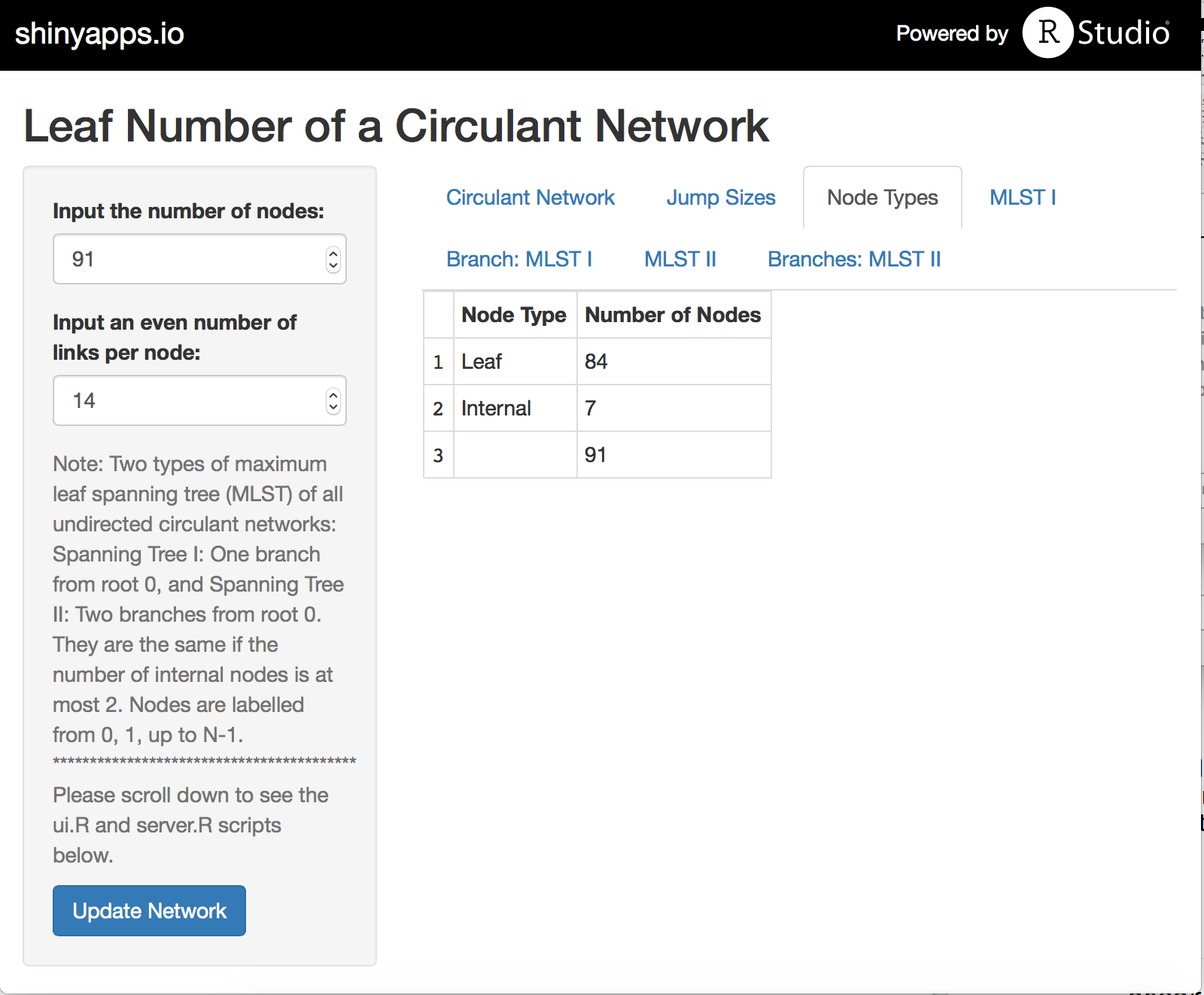
  • To minimize the number of repeater nodes is to find a spanning tree with the minimum number of internal nodes or with the maximum number of leaf nodes. This is the Maximum Leaf Spanning Tree (MLST).

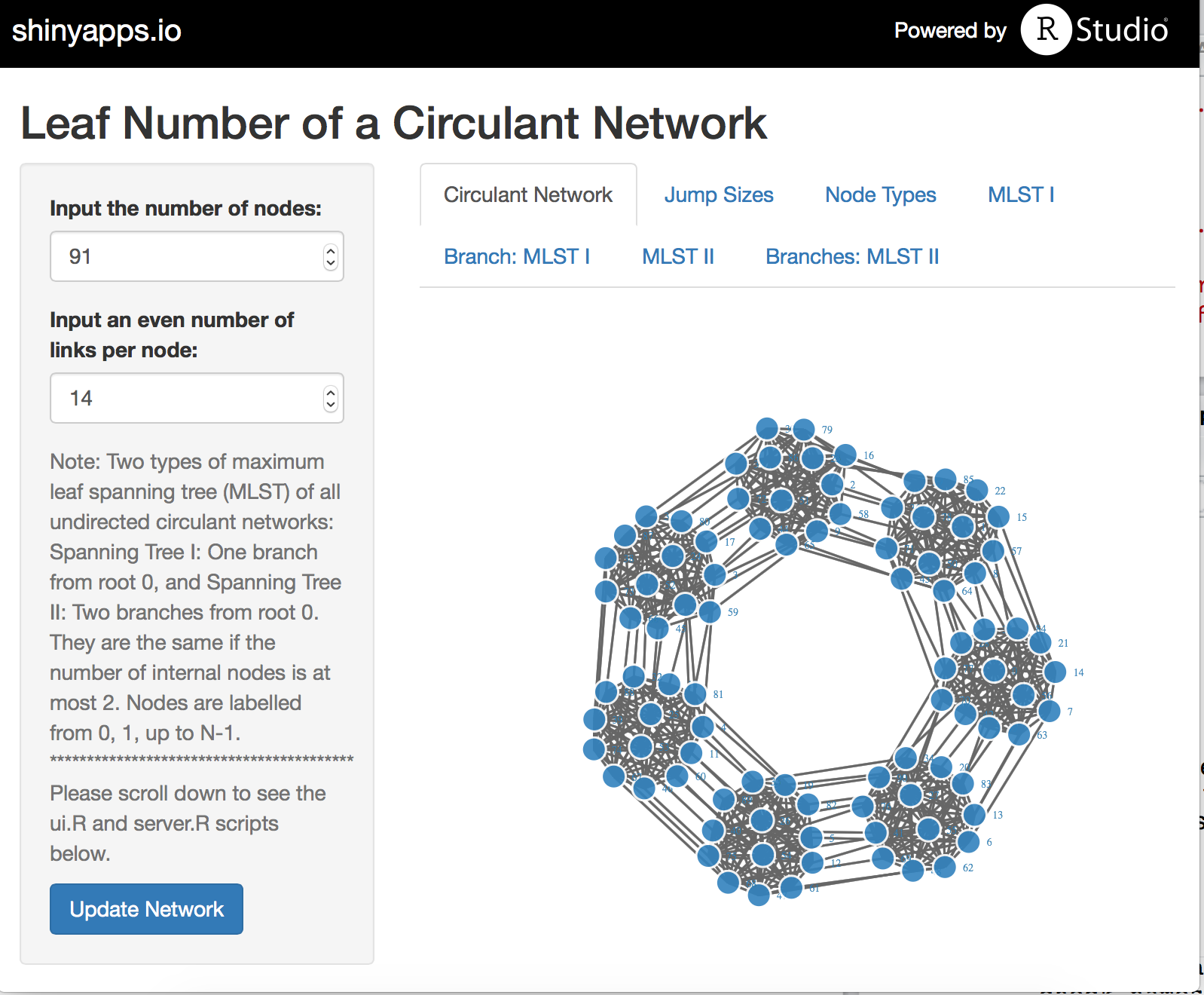
A Communication Network Configured as a Circulant Graph with 91 Nodes and 14 Nodal Links

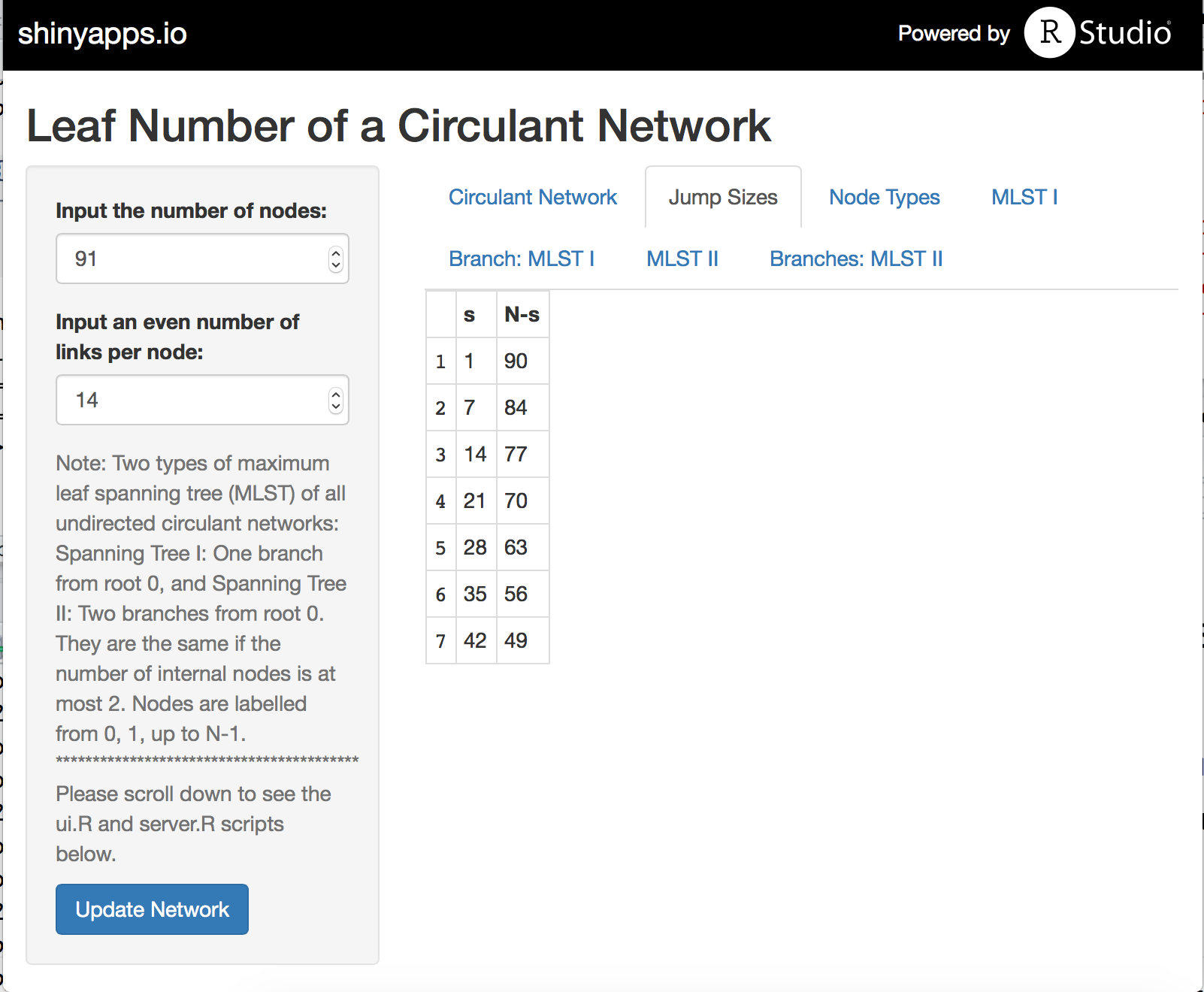
Consider the undirected circulant graph with 91 nodes and 14 links per node. The jump sizes of this graph that has the leaf number property is given below:

##  [1]  1  7 14 21 28 35 42 49 56 63 70 77 84 90

Down arrow Down arrow Down arrow

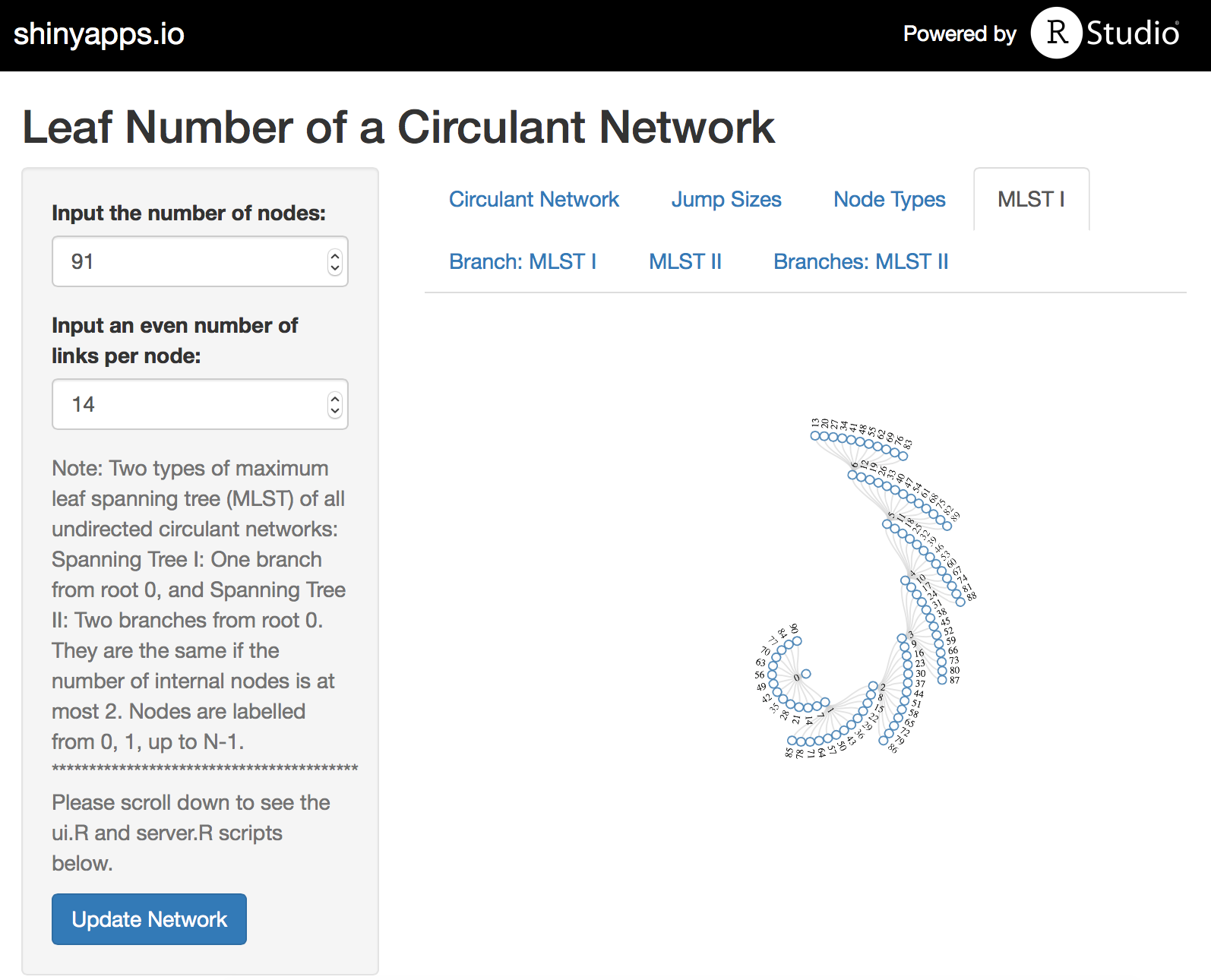
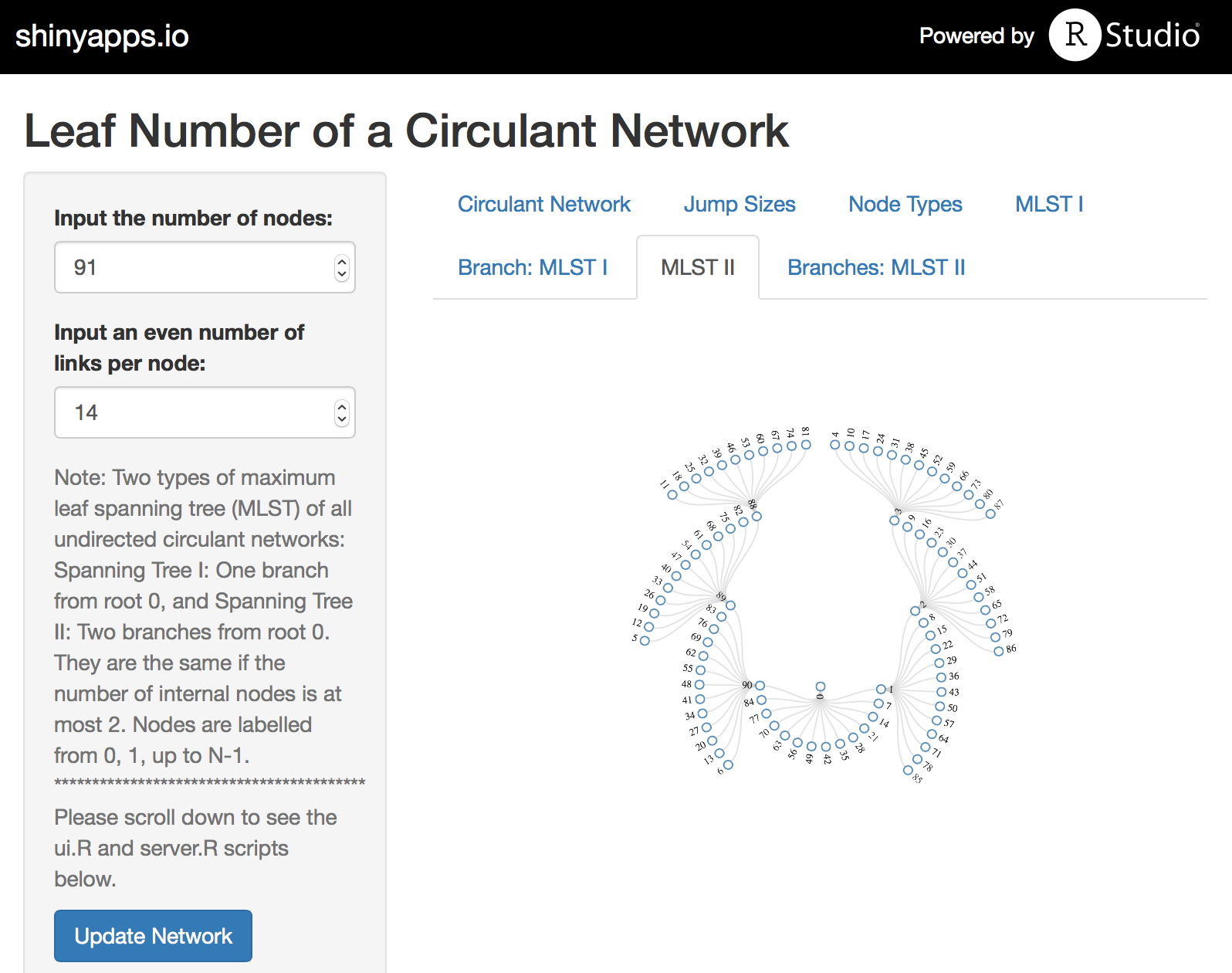
MLST of the Circulant Graph with 91 Nodes and 14 Nodal Links