Machine Learning Methods for Modeling and Classification of Fashion-MNIST

David Blumenstiel, Bonnie Cooper, Robert Welk, Leo Yi
"2021-12-10"

Project Goal: apply dimensionality reduction techniques to the Fashion MNIST dataset and evaluate the effectiveness of the results for classification using a variety of machine learning algorithms

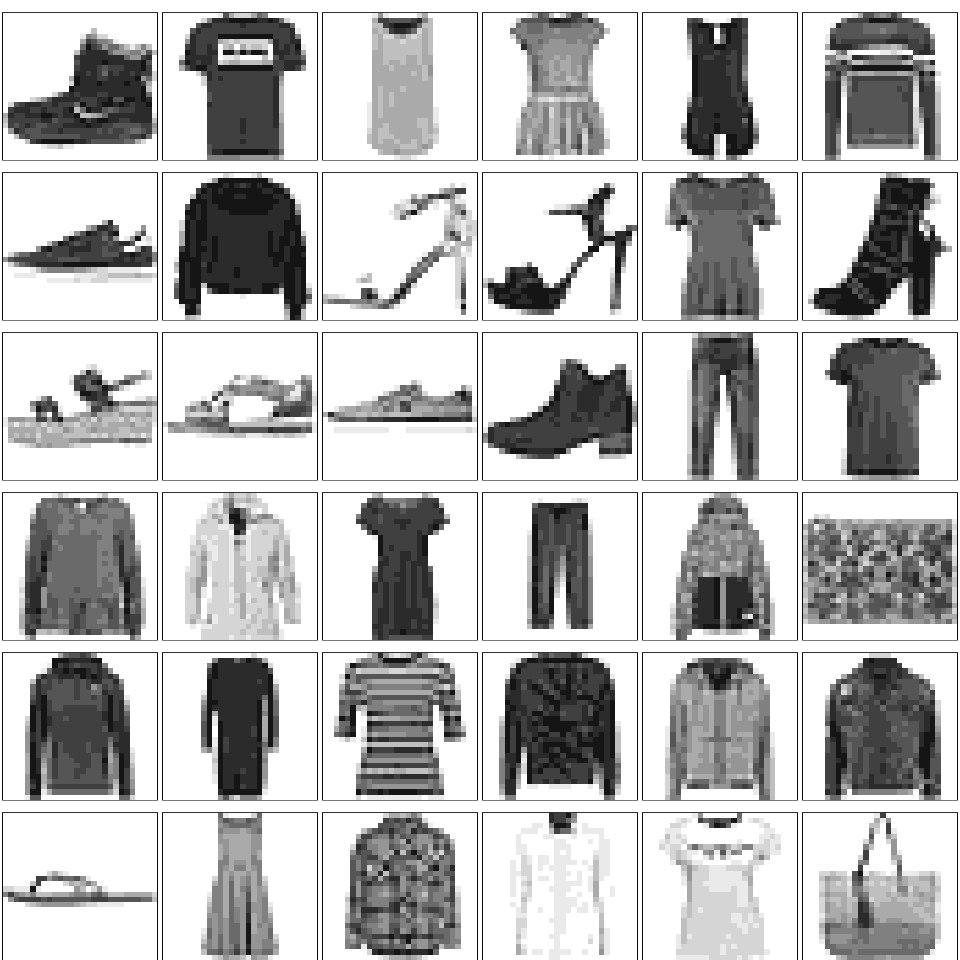
Fashion MNIST

  • dataset of clothing images labeled by item category
  • 60k training images, 10k test images
  • images: grayscale, 28x28 pixels
  • more challenging substitute for MNIST


Our Approach


  • 2 different approaches to dimensionality reduction:
    • Feature Engineering
    • Principal Component Analysis
  • Compare Performance of models trained with or without dimensionality reduction
  • Evaluate the performance of a variety of models trained with dimensionality reduction

Why Dimensionality Reduction?

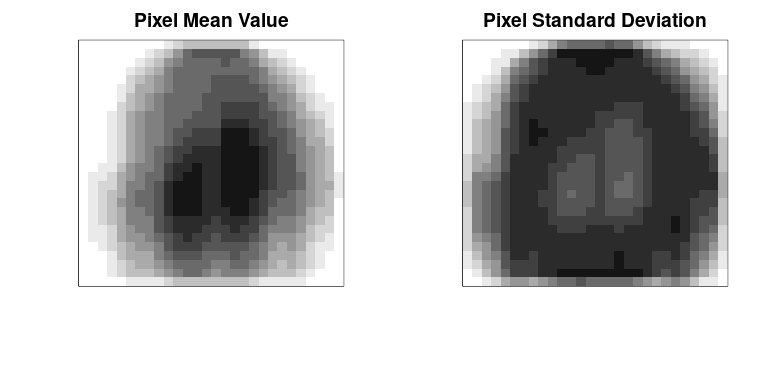
Not all pixels are informative

  • Many pixels in the periphery have consistently low values
  • Some pixels in the center have consistently high values
  • this redundancy suggests we can reduce the feature space to more efficiently represent the data


Dimensionality Reduction: Feature Engineering
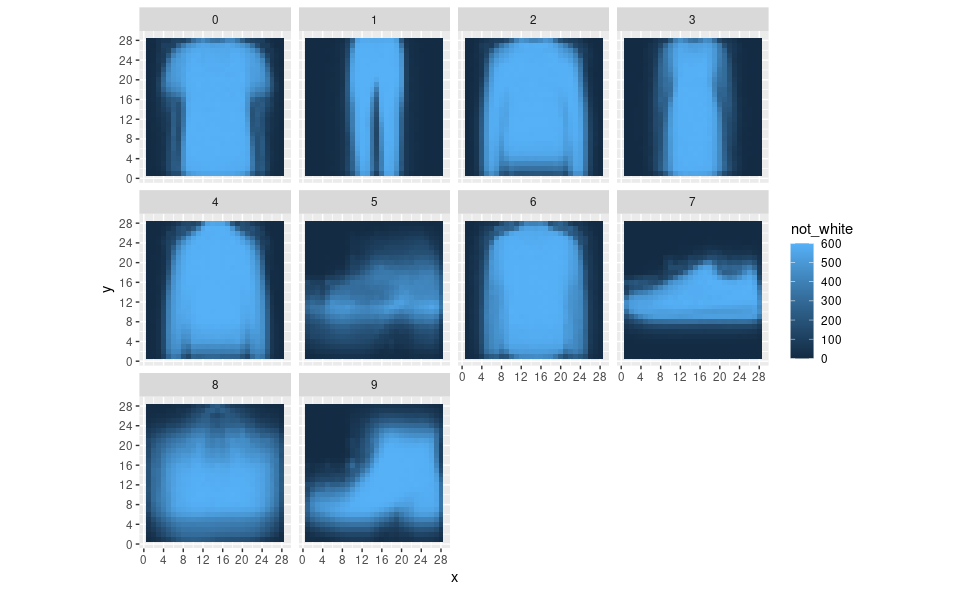

  • We observed categorical patterns in the pixel values
  • We engineered a new feature based on the patterns
  • Reduced the number of features from 784 \( \rightarrow \) ~80


Modeling Fashion-MNIST with the Feature Engineered Dataset


We trained multiple machine learning models for classification on the engineered feature set:

  • Random Forest
  • Support Vector Machine
  • k-Nearest Neighbor
  • Multinomial logistic regression
  • Naive Bayes

We found radial SVM performed best. However, Random Forest had comparable performance and trained much faster

Model Type Training Duration Test Accuracy
SVM (radial) 19.0 0.856
Mult. Log. Reg. 9.3 0.824
Random Forest 5.5 0.855
kNN 2.6 0.795
Naive Bayes 0.2 0.713

Dimensionality Reduction: PCA

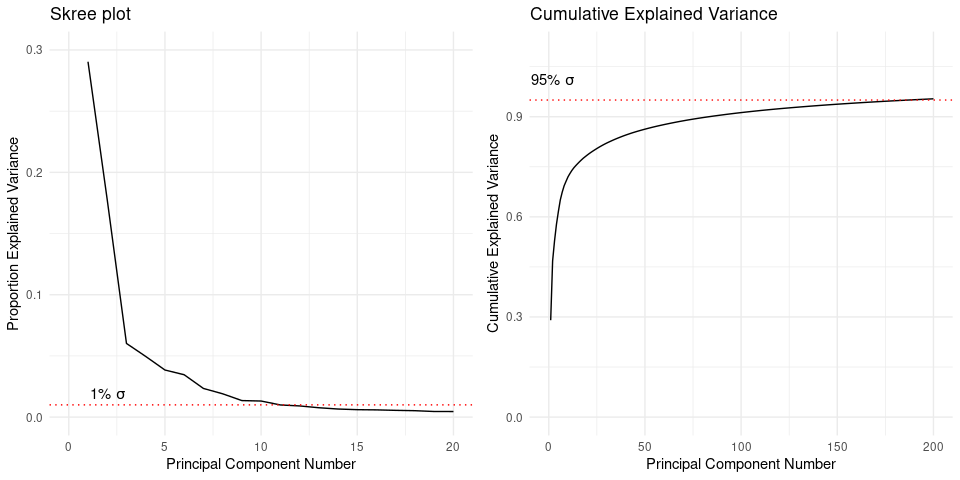
  • We performed PCA on the 784 pixel value features from the original dataset.
  • The skree plot (left) shows that the first ~12 components describe most of the data variance
  • The Cumulative Explained Variance plot (right) shows that 95% of the variance can be explained by the first 187 components
kNN with & without PCA dimensionality reduction
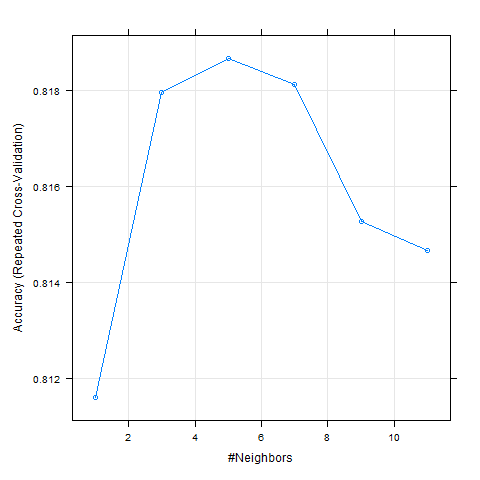
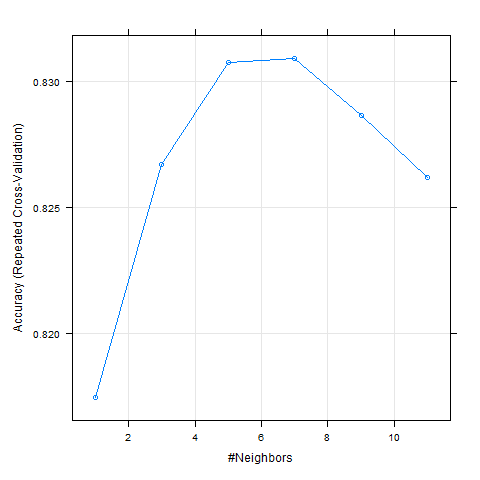
  • We trained kNN models on the original & the PCA feature sets
  • hyperparameter tuning curves for original (top) & PCA (bottom)
  • PCA kNN model performs slightly better (82.35% vs 81.23% overall accuracy; a significant difference at α = 0.05)
  • we hypothesize that PCA performs better because of increased separability

Modeling Fashion-MNIST using PCA: Additional Machine Learning Models
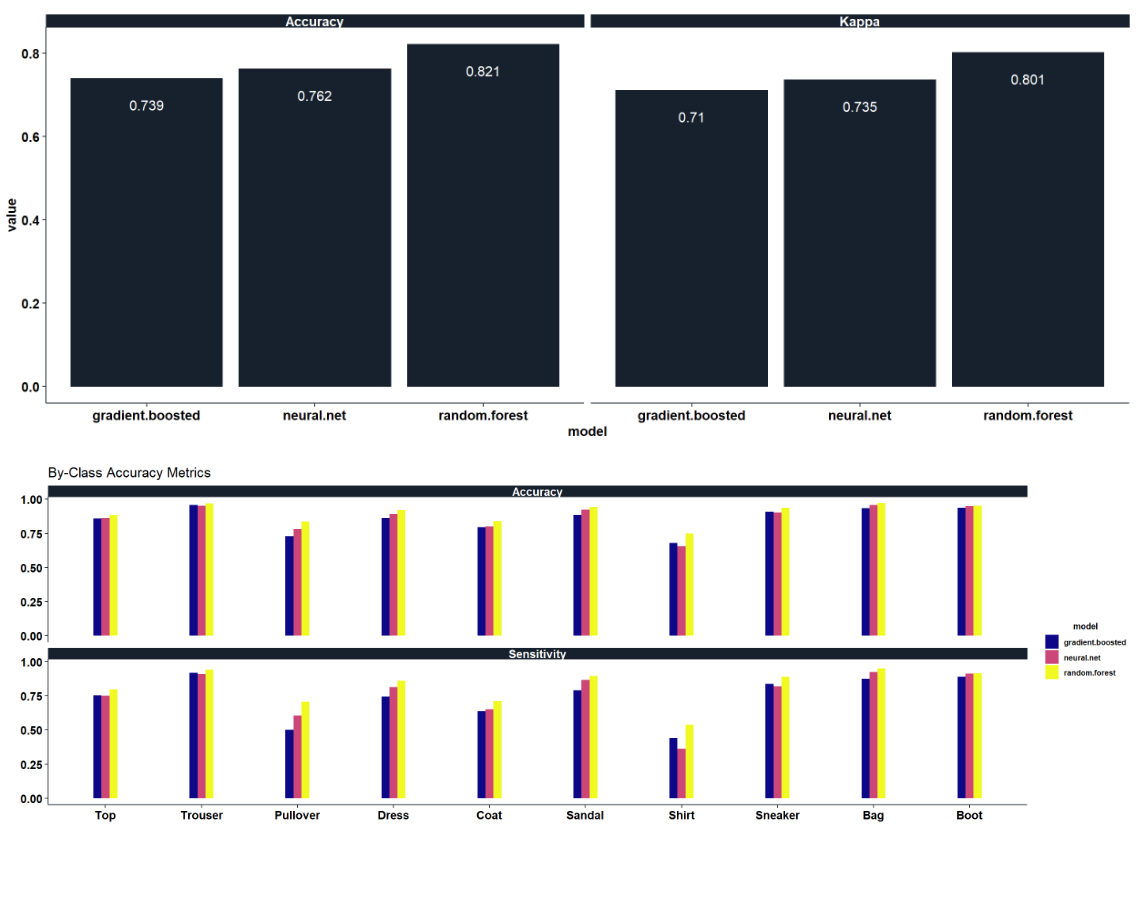
  • To further evaluate classification with the PCA set, we trained the following models:
    • Stochastic Gradient Boosting
    • Random Forest
    • a Neural Network
  • Based on Accuracy & Kappa, Random Forest had the best overall performance to classify the test data (top panel)
  • Based on Accuracy & Sensitivity, Random Forest performed best by category
  • All models struggled with the same categories (e.g. 'Shirt')


Summary & Conclusions

  • We used a feature engineering approach to reduce the dimensionality of Fashion-MNIST from 784 \( \rightarrow \) to ~80 features. The resulting dataset trained faster and yielded acceptable classification accuracy. Radial SVM performed the best, but Random Forest had similar results with a shorter training duration.
  • We also used PCA to reduce Fashion-MNIST dimensionality from 784 \( \rightarrow \) 187 features. For kNN model fits, we found a slight improvement in classification accuracy with PCA. Furthermore, we demonstrated improved accuracy with other machine learning models; Random Forest performed the best.
  • In conclusion, we find dimensionality reduction to be a powerful means to facilitate classification tasks when using large and high-dimensional data.


Thank you for your attention