Called to Proclaim: Luke 4:14-22
# Convert to dataframe


bible <- enframe(bible)
## verse
## 1 Luke 4:1
## 2 Luke 4:2
## 3 Luke 4:10
## 4 Luke 4:11
## 5 Luke 4:12
## 6 Luke 4:13
## 7 Luke 4:14
## 8 Luke 4:15
## 9 Luke 4:16
## 10 Luke 4:17
## 11 Luke 4:18
## 12 Luke 4:19
## 13 Luke 4:20
## 14 Luke 4:21
## 15 Luke 4:22
## 16 Luke 4:23
## 17 Luke 4:24
## 18 Luke 4:25
## 19 Luke 4:26
## 20 Luke 4:27
## 21 Luke 4:28
## 22 Luke 4:29
## text
## 1 Then Jesus, full of the Holy Spirit, returned from the Jordan and was led by the Spirit into the wilderness,
## 2 where for forty days He was tempted by the devil. He ate nothing during those days, and when they had ended, He was hungry.
## 3 For it is written: ‘He will command His angels concerning You to guard You carefully;
## 4 and they will lift You up in their hands, so that You will not strike Your foot against a stone.’”
## 5 But Jesus answered, “It also says, ‘Do not put the Lord your God to the test.’”
## 6 When the devil had finished every temptation, he left Him until an opportune time.
## 7 Jesus returned to Galilee in the power of the Spirit, and the news about Him spread throughout the surrounding region.
## 8 He taught in their synagogues and was glorified by everyone.
## 9 Then Jesus came to Nazareth, where He had been brought up. As was His custom, He entered the synagogue on the Sabbath. And when He stood up to read,
## 10 the scroll of the prophet Isaiah was handed to Him. Unrolling it, He found the place where it was written:
## 11 “The Spirit of the Lord is on Me, because He has anointed Me to preach good news to the poor. He has sent Me to proclaim liberty to the captives and recovery of sight to the blind, to release the oppressed,
## 12 to proclaim the year of the Lord’s favor.”
## 13 Then He rolled up the scroll, returned it to the attendant, and sat down. The eyes of everyone in the synagogue were fixed on Him,
## 14 and He began by saying, “Today this Scripture is fulfilled in your hearing.”
## 15 All spoke well of Him and marveled at the gracious words that came from His lips. “Isn’t this the son of Joseph?” they asked.
## 16 Jesus said to them, “Surely you will quote this proverb to Me: ‘Physician, heal yourself! Do here in Your hometown what we have heard that You did in Capernaum.’”
## 17 Then He added, “Truly I tell you, no prophet is accepted in his hometown.
## 18 But I tell you truthfully that there were many widows in Israel in the time of Elijah, when the sky was shut for three and a half years and great famine swept over all the land.
## 19 Yet Elijah was not sent to any of them, but to the widow of Zarephath in Sidon.
## 20 And there were many lepers in Israel in the time of Elisha the prophet. Yet not one of them was cleansed—only Naaman the Syrian.”
## 21 On hearing this, all the people in the synagogue were enraged.
## 22 They got up, drove Him out of the town, and led Him to the brow of the hill on which the town was built, in order to throw Him over the cliff.Unscramble the following letters to create two words: EMOOWNTH ROEH
#HOMETOWN HERO
Before moving on to the text, let’s briefly review what we talked about last month.(look at the context of the lesson from last month. Go through the title of each lesson and reference the verses. 5 minutes.)
Continuing the theme of Vocation or calling, today we will be reading from Luke and the idea of being “Called to Proclaim”.
Before jumping into the text today, I wanted to discuss the idea of returning home in the sense of one’s family. For college student’s this could be the differences in how their family perceive them versus their college campus and for those who are working this could be the difference between how people at work or your neightborhood perceive you versus your families perception of you at family gatherings. Briefly talk about some of the differences.
Jesus had to face the people he grew up with and challenge their perceptions about him as well. Let’s read Luke 4:14-22.
The entry goes onto say that “most modern commentators on the Lucan gospel are skeptical about the validity of this traditional attribution” (The Oxford Companion to the Bible 470).
Geographically, where was Jesus?

https://www.conformingtojesus.com/images/webpages/israel_at_the_time_of_jesus_christ_1.png
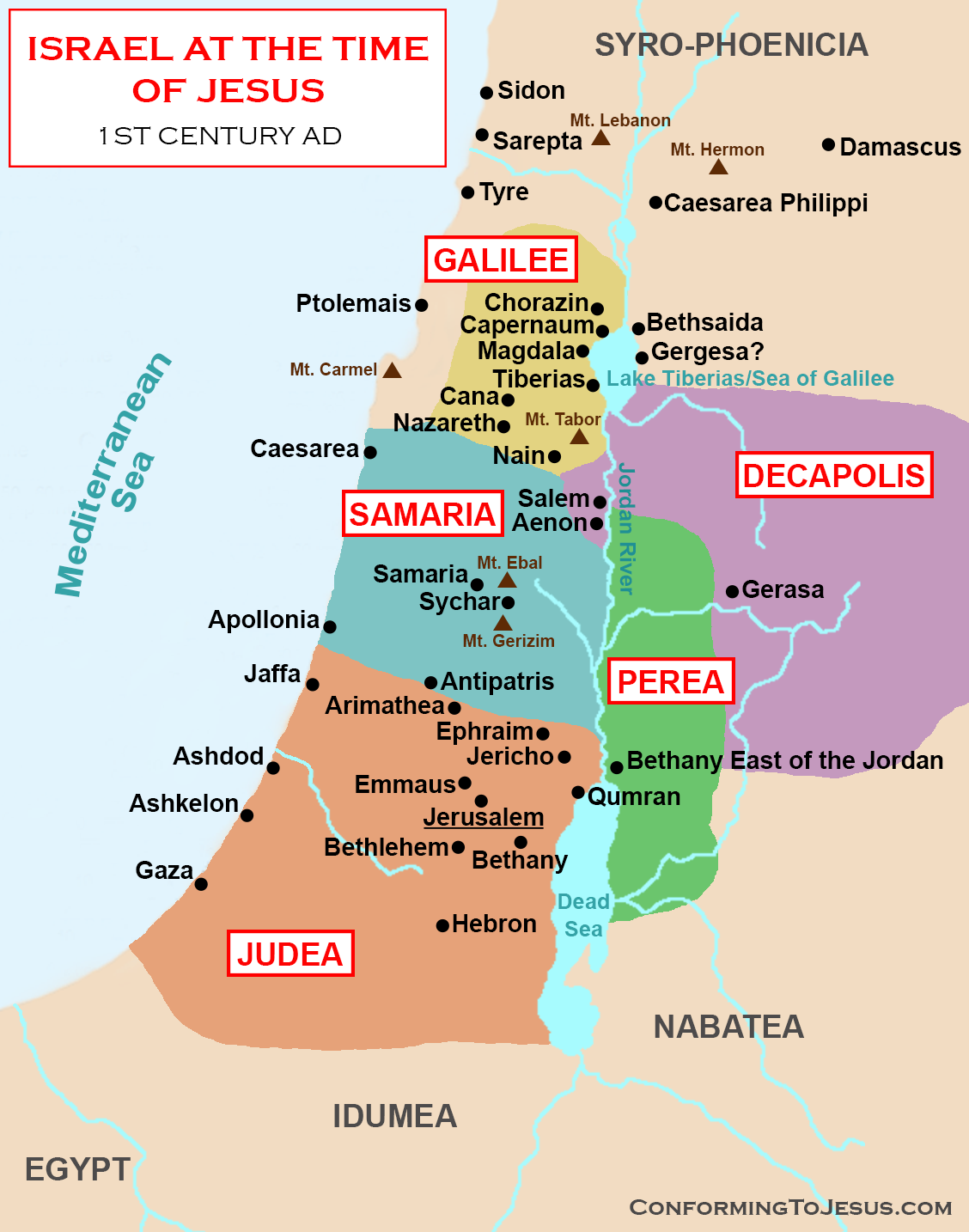
What is meant by “in the power of the spirit” v.14? Leading question, what happened just prior to our passage?
response: (Jesus was in the Wilderness for 40 days and faces Satan.) Whether this is the correct sequence of events or not, the power and presence of the Spirit in Jesus is evident. As Jesus is teaching throughout Galilee, word is spreading about him.
response: from Strong’s Greek translation of doxazó “to render or esteem glorious (in a wide application)” (Bible Hub). https://biblehub.com/interlinear/luke/4-15.htm
response: Do those same reasons apply to you?
Why quote Isaiah 61:1,2?
“The Spirit of the Sovereign Lord is on me, because the Lord has anointed me to proclaim good news to the poor. He has sent me to bind up the brokenhearted, to proclaim freedom for the captives and release from darkness for the prisoners,[a] to proclaim the year of the Lord’s favor and the day of vengeance of our God, to comfort all who mourn,”
Who is “me”? Who are the “poor”?
What did this scroll look like?
response: There were were no chapters and verses in Isaiah, that didn’t come until the fourth century [January 1, 301 AD – December 31, 400 AD] (http://www.blueletterbible.org/Comm/stewart_don/faq/bible-special/question8-why-is-the-bible-divided-into-chapters-and-verses.cfm)
After he reads all this, Jesus goes and sits down. Then he has a mic drop moment where he says, “Today this scripture is fulfilled in your hearing.” What would be some of the thoughts going through your mind at this point, if you were sitting beside Jesus and he said that?
response: What? Really? No way! Jesus? Kind of a cocky thing to say.
From the commentary, “what percentage of your Bible study time should you devote to reading the Old Testament? Why?”
response: There are 10,220 verses in the Old Testament compared to the New Testament which has 6,472. The New testament references the Old Testament 855 times (http://www.blueletterbible.org/study/pnt/pnt08.cfm), this all goes to show the importance of the Old Testament, however, I am not sure the time you put into studying the old testament is the biggest takeaway, as is the importance of “knowing” the old testament.
sqldf("SELECT count(verse) AS 'Number of Verses in OT'
      FROM bible
      WHERE verse BETWEEN 'Genesis 1:1' AND 'Malachi 4:6'")
## Number of Verses in OT
## 1 10220sqldf("SELECT count(verse) AS 'Number of Verses in NT'
FROM bible
WHERE verse BETWEEN 'Matthew 1:1' AND 'Revelations 22:5'")## Number of Verses in NT
## 1 6472