Harsh Baxi
April 23, 2017
The webpage European Option Valuation provides a tool valuing European call and put options using the Black-Scholes equations.
The page was created using R Markdown, Shiny and Plotly and is meant to be used in two ways:
The equations below can be used to calculate the price of “vanilla” European call and put options for non-dividend paying stocks: \[ \tiny c = S_{0}N(d_{1}) - K e^{-rT}N(d_{2}) \]
\[ \tiny p = K e^{-rT}N(-d_{2}) - S_{0}N(-d_{1}) \]
\[ \tiny d_{1} = \frac{ln(S_{0}/K) + (r + \sigma^{2}/2)T}{\sigma\sqrt{T}} \]
\[ \tiny d_{2} = \frac{ln(S_{0}/K) + (r - \sigma^{2}/2)T}{\sigma\sqrt{T}} \]
where,
c = Call Option Value
p = Put Option Value
\( S_0 \) = Stock Price
K = Strike Price
r = Risk-free Interest Rate
T = Time to Expiry,
\( \sigma \) = Volatility
N() = Normal cumulative distribution function
The following code shows how the Black-Scholes Equations are implemented in R.
# the rate, strike price, volatility and time to expiry are supplied as inputs via the Shiny controls
input <- data.frame("rate" = 1, "strike" = 50, volatility = 30, timeToExpiryMonths = 12, putcall = "call")
r <- input$rate / 100
k <- input$strike
v <- input$volatility / 100
t <- input$timeToExpiryMonths / 12
# the application calculates the option values for the range of stock prices from 0 to twice the strike price selected by the user. Here we set the stock price equal to the strike price
s <- k
# code that implements the Black-Scholes Equations
d1 <- (log(s / k) + (r + v ^ 2 / 2) * t) / (v * sqrt(t))
d2 <- (log(s / k) + (r - v ^ 2 / 2) * t) / (v * sqrt(t))
if (input$putcall == "call")
value = s * pnorm(d1) - k * exp(-r * t) * pnorm(d2) else
value = k * exp(-r * t) * pnorm(-d2) - s * pnorm(-d1)
print(paste("Option Value: $", round(value,2)))
[1] "Option Value: $ 6.18"
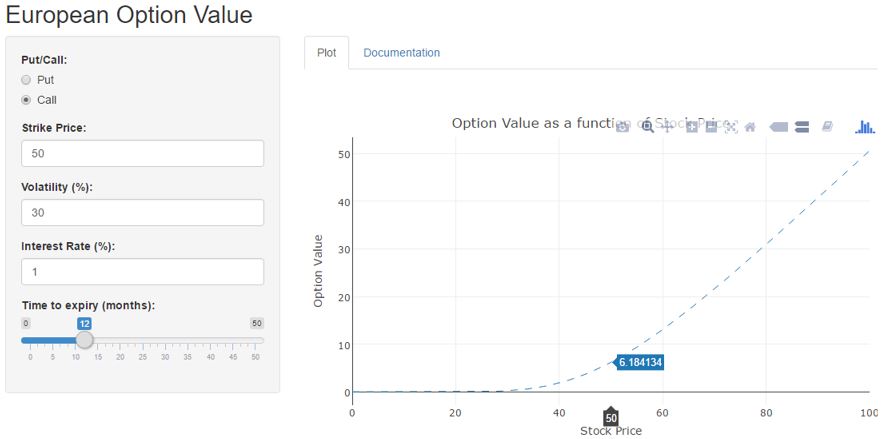
The option value calculated in the previous slide can be read off the graph as shown below:
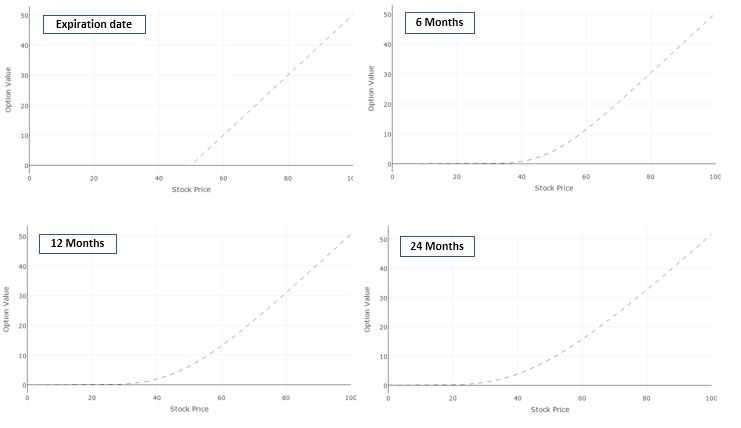
The plot below shows how the webpage can be used to illustrate the effect of inputs (“Time to Expiry” in this case) on the option values: