Alencar Xavier
- Quantitative Geneticist, Corteva Agrisciences
- Adjunct professor, Purdue University
- http://alenxav.wixsite.com/home/
Gota Morota
- Assistent professor, Virginia Tech
- http://morotalab.org/
October 26, 2018
Alencar Xavier
Gota Morota
Part 1: Concepts
Part 2: Applications
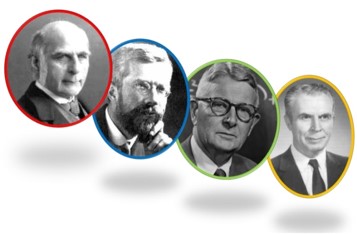
Francis Galton - 1886: Regression and heritability
Ronald Fisher - 1918: Infinitesimal model (P = G + E)
Sewall Wright - 1922: Genetic relationship
Charles Henderson - 1950, 1968: BLUP using relationship
Fixed effect
Random effects

Assuming: \(u \sim N(0,K\sigma^{2}_{u})\) and \(e \sim N(0,I\sigma^{2}_{e})\)
Henderson equation
\[ \left[\begin{array}{rr} X'X & Z'X \\ X'Z & Z'Z+\lambda K^{-1} \end{array}\right] \left[\begin{array}{r} b \\ u \end{array}\right] =\left[\begin{array}{r} X'y \\ Z'y \end{array}\right] \] Summary:
The mixed model can also be notated as follows
\[y=Wg+e\]
Solved as
\[[W'W+\Sigma] g = [W'y]\]
Where
\(W=[X,Z]\)
\(g=[b,u]\)
\(\Sigma = \left[\begin{array}{rr} 0 & 0 \\ 0 & \lambda K^{-1} \end{array}\right]\)
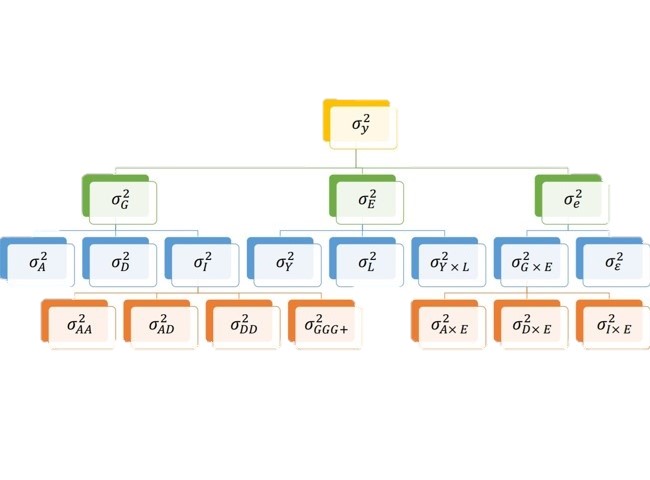
1 Genetic values
2 Breeding values
3 Genomic Breeding values
Data:
##    Env Gen Phe
## 1   E1  G1  47
## 2   E1  G2  51
## 3   E1  G3  46
## 4   E1  G4  58
## 5   E2  G1  52
## 6   E2  G2  46
## 7   E2  G3  52
## 8   E2  G4  54
## 9   E3  G1  53
## 10  E3  G2  48
## 11  E3  G3  58
## 12  E3  G4  52
Model: \(Phenotype = Environment_{(F)} + Genotype_{(R)}\)
Design matrix \(W\):
##    EnvE1 EnvE2 EnvE3 GenG1 GenG2 GenG3 GenG4
## 1      1     0     0     1     0     0     0
## 2      1     0     0     0     1     0     0
## 3      1     0     0     0     0     1     0
## 4      1     0     0     0     0     0     1
## 5      0     1     0     1     0     0     0
## 6      0     1     0     0     1     0     0
## 7      0     1     0     0     0     1     0
## 8      0     1     0     0     0     0     1
## 9      0     0     1     1     0     0     0
## 10     0     0     1     0     1     0     0
## 11     0     0     1     0     0     1     0
## 12     0     0     1     0     0     0     1
\(W'W\):
##       EnvE1 EnvE2 EnvE3 GenG1 GenG2 GenG3 GenG4
## EnvE1     4     0     0     1     1     1     1
## EnvE2     0     4     0     1     1     1     1
## EnvE3     0     0     4     1     1     1     1
## GenG1     1     1     1     3     0     0     0
## GenG2     1     1     1     0     3     0     0
## GenG3     1     1     1     0     0     3     0
## GenG4     1     1     1     0     0     0     3
Left-hand side (\(W'W+\Sigma\)):
##       EnvE1 EnvE2 EnvE3 GenG1 GenG2 GenG3 GenG4
## EnvE1     4     0     0  1.00  1.00  1.00  1.00
## EnvE2     0     4     0  1.00  1.00  1.00  1.00
## EnvE3     0     0     4  1.00  1.00  1.00  1.00
## GenG1     1     1     1  3.17  0.00  0.00  0.00
## GenG2     1     1     1  0.00  3.17  0.00  0.00
## GenG3     1     1     1  0.00  0.00  3.17  0.00
## GenG4     1     1     1  0.00  0.00  0.00  3.17
Assuming independent individuals: \(K=I\)
Regularization: \(\lambda=\sigma^{2}_{e}/\sigma^{2}_{u}=1.64/9.56=0.17\)
Right-hand side (\(W'y\)):
##       [,1]
## EnvE1  202
## EnvE2  204
## EnvE3  211
## GenG1  152
## GenG2  145
## GenG3  156
## GenG4  164
We can find coefficients through least-square solution
\(g=(LHS)^{-1}(RHS)=(W'W+\Sigma)^{-1}W'y\)
##        [,1]
## EnvE1 50.50
## EnvE2 51.00
## EnvE3 52.75
## GenG1 -0.71
## GenG2 -2.92
## GenG3  0.55
## GenG4  3.08
\(BLUE=\frac{w'y}{w'w}=\frac{sum}{n}\) = simple average
\(BLUP=\frac{w'y}{w'w+\lambda}=\frac{sum}{n+\lambda}\) = biased average = \(BLUE\times h^2\)
Note:
If we know the relationship among individuals:
##       GenG1 GenG2 GenG3 GenG4
## GenG1  1.00  0.64  0.23  0.48
## GenG2  0.64  1.00  0.33  0.67
## GenG3  0.23  0.33  1.00  0.31
## GenG4  0.48  0.67  0.31  1.00
Then we estimate \(\lambda K^{-1}\)
##       GenG1 GenG2 GenG3 GenG4
## GenG1  0.15 -0.09  0.00 -0.01
## GenG2 -0.09  0.22 -0.02 -0.10
## GenG3  0.00 -0.02  0.10 -0.02
## GenG4 -0.01 -0.10 -0.02  0.17
Regularization: \(\lambda=\sigma^{2}_{e}/\sigma^{2}_{u}=1.64/17.70=0.09\)
And the left-hand side becomes
##       EnvE1 EnvE2 EnvE3 GenG1 GenG2 GenG3 GenG4
## EnvE1     4     0     0  1.00  1.00  1.00  1.00
## EnvE2     0     4     0  1.00  1.00  1.00  1.00
## EnvE3     0     0     4  1.00  1.00  1.00  1.00
## GenG1     1     1     1  3.15 -0.09  0.00 -0.01
## GenG2     1     1     1 -0.09  3.22 -0.02 -0.10
## GenG3     1     1     1  0.00 -0.02  3.10 -0.02
## GenG4     1     1     1 -0.01 -0.10 -0.02  3.17
We can find coefficients through least-square solution
\(g=(LHS)^{-1}(RHS)=(W'W+\Sigma)^{-1}W'y\)
##        [,1]
## EnvE1 51.05
## EnvE2 51.55
## EnvE3 53.30
## GenG1 -1.32
## GenG2 -3.34
## GenG3  0.03
## GenG4  2.45
Genetic coefficients shrink more: Var(A) < Var(G)
What if we have missing data?
##    Env Gen Phe
## 1   E1  G1  47
## 2   E1  G2  51
## 3   E1  G3  NA
## 4   E1  G4  58
## 5   E2  G1  52
## 6   E2  G2  46
## 7   E2  G3  52
## 8   E2  G4  NA
## 9   E3  G1  53
## 10  E3  G2  48
## 11  E3  G3  58
## 12  E3  G4  52
Rows of missing points are removed
##    EnvE1 EnvE2 EnvE3 GenG1 GenG2 GenG3 GenG4
## 1      1     0     0     1     0     0     0
## 2      1     0     0     0     1     0     0
## 4      1     0     0     0     0     0     1
## 5      0     1     0     1     0     0     0
## 6      0     1     0     0     1     0     0
## 7      0     1     0     0     0     1     0
## 9      0     0     1     1     0     0     0
## 10     0     0     1     0     1     0     0
## 11     0     0     1     0     0     1     0
## 12     0     0     1     0     0     0     1
\(W'W\):
##       EnvE1 EnvE2 EnvE3 GenG1 GenG2 GenG3 GenG4
## EnvE1     3     0     0     1     1     0     1
## EnvE2     0     3     0     1     1     1     0
## EnvE3     0     0     4     1     1     1     1
## GenG1     1     1     1     3     0     0     0
## GenG2     1     1     1     0     3     0     0
## GenG3     0     1     1     0     0     2     0
## GenG4     1     0     1     0     0     0     2
Left-hand side (\(W'W+\Sigma\)):
##       EnvE1 EnvE2 EnvE3 GenG1 GenG2 GenG3 GenG4
## EnvE1     3     0     0  1.00  1.00  0.00  1.00
## EnvE2     0     3     0  1.00  1.00  1.00  0.00
## EnvE3     0     0     4  1.00  1.00  1.00  1.00
## GenG1     1     1     1  3.10 -0.06  0.00 -0.01
## GenG2     1     1     1 -0.06  3.15 -0.01 -0.07
## GenG3     0     1     1  0.00 -0.01  2.07 -0.01
## GenG4     1     0     1 -0.01 -0.07 -0.01  2.11
Regularization: \(\lambda=\sigma^{2}_{e}/\sigma^{2}_{u}=1.21/19.61=0.06\)
Right-hand side (\(W'y\)):
##       [,1]
## EnvE1  156
## EnvE2  150
## EnvE3  211
## GenG1  152
## GenG2  145
## GenG3  110
## GenG4  110
Find coefficients through least-square solution
\(g=(LHS)^{-1}(RHS)=(W'W+\Sigma)^{-1}W'y\)
##        [,1]
## EnvE1 54.14
## EnvE2 51.70
## EnvE3 53.82
## GenG1 -2.56
## GenG2 -4.68
## GenG3  2.15
## GenG4  0.81
What if we are missing data from a individual?
##    Env Gen Phe
## 1   E1  G1  NA
## 2   E1  G2  51
## 3   E1  G3  46
## 4   E1  G4  58
## 5   E2  G1  NA
## 6   E2  G2  46
## 7   E2  G3  52
## 8   E2  G4  54
## 9   E3  G1  NA
## 10  E3  G2  48
## 11  E3  G3  58
## 12  E3  G4  52
Rows of missing points are removed
##    EnvE1 EnvE2 EnvE3 GenG1 GenG2 GenG3 GenG4
## 2      1     0     0     0     1     0     0
## 3      1     0     0     0     0     1     0
## 4      1     0     0     0     0     0     1
## 6      0     1     0     0     1     0     0
## 7      0     1     0     0     0     1     0
## 8      0     1     0     0     0     0     1
## 10     0     0     1     0     1     0     0
## 11     0     0     1     0     0     1     0
## 12     0     0     1     0     0     0     1
\(W'W\):
##       EnvE1 EnvE2 EnvE3 GenG1 GenG2 GenG3 GenG4
## EnvE1     3     0     0     0     1     1     1
## EnvE2     0     3     0     0     1     1     1
## EnvE3     0     0     3     0     1     1     1
## GenG1     0     0     0     0     0     0     0
## GenG2     1     1     1     0     3     0     0
## GenG3     1     1     1     0     0     3     0
## GenG4     1     1     1     0     0     0     3
Left-hand side (\(W'W+\Sigma\)):
##       EnvE1 EnvE2 EnvE3 GenG1 GenG2 GenG3 GenG4
## EnvE1     3     0     0  0.00  1.00  1.00  1.00
## EnvE2     0     3     0  0.00  1.00  1.00  1.00
## EnvE3     0     0     3  0.00  1.00  1.00  1.00
## GenG1     0     0     0  0.14 -0.08  0.00 -0.01
## GenG2     1     1     1 -0.08  3.19 -0.02 -0.09
## GenG3     1     1     1  0.00 -0.02  3.09 -0.01
## GenG4     1     1     1 -0.01 -0.09 -0.01  3.15
Regularization: \(\lambda=\sigma^{2}_{e}/\sigma^{2}_{u}=1.79/22.78=0.08\)
Right-hand side (\(W'y\)):
##       [,1]
## EnvE1  155
## EnvE2  152
## EnvE3  158
## GenG1    0
## GenG2  145
## GenG3  156
## GenG4  164
Find coefficients through least-square solution
\(g=(LHS)^{-1}(RHS)=(W'W+\Sigma)^{-1}W'y\)
##        [,1]
## EnvE1 52.06
## EnvE2 51.06
## EnvE3 53.06
## GenG1 -1.82
## GenG2 -3.48
## GenG3 -0.07
## GenG4  2.38
Expectation-Maximization REML (1977)
\(\sigma^{2}_{u} = \frac{u'K^{-1}u}{q-\lambda tr(K^{-1}C^{22})}\) and \(\sigma^{2}_{e} = \frac{e'y}{n-p}\)
Bayesian Gibbs Sampling (1993)
\(\sigma^{2}_{u} = \frac{u'K^{-1}u+S_u\nu_u}{\chi^2(q+\nu_u)}\) and \(\sigma^{2}_{e} = \frac{e'e+S_e\nu_e}{\chi^2(n+\nu_e)}\)
Predicted Residual Error Sum of Squares (PRESS) (2017)
Kernel methods:
Ridge methods:
Kernel
\(y=Xb+Zu+e\), \(u\sim N(0,K\sigma^2_u)\)
Ridge
\(y=Xb+Ma+e\), \(a\sim N(0,I\sigma^2_a)\)
Where
Kernel model
\[ \left[\begin{array}{rr} X'X & Z'X \\ X'Z & Z'Z+K^{-1}(\sigma^2_e/\sigma^2_u) \end{array}\right] \left[\begin{array}{r} b \\ u \end{array}\right] =\left[\begin{array}{r} X'y \\ Z'y \end{array}\right] \]
Ridge model
\[ \left[\begin{array}{rr} X'X & M'X \\ X'M & M'M+I^{-1}(\sigma^2_e/\sigma^2_a) \end{array}\right] \left[\begin{array}{r} b \\ a \end{array}\right] =\left[\begin{array}{r} X'y \\ M'y \end{array}\right] \]
Both models capture same genetic signal (de los Campos 2015)
K = tcrossprod(M)/ncol(M)
GBLUP = reml(y=y,K=K); Kernel_GEBV = GBLUP$EBV
RRBLUP = reml(y=y,Z=M); Ridge_GEBV = M%*%RRBLUP$EBV
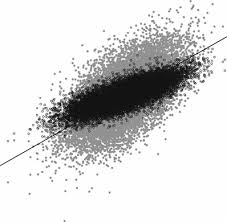
plot(Kernel_GEBV,Ridge_GEBV, main='Comparing results')
