International Conference on Transport and Health (ICTH), Mackinac Island 2018-06-24.

Outline

  • Part I: Who, Why and What (can they do)?
  • Context (15 minutes)
  • The Propensity to Cycle Tool (15 minutes on thePCT)
  • The Cycling Infrastructure Prioritisation Tool (5 minutes on the CyIPT)
  • Live demo (10 minutes)
  • Interactive exercise in groups (45 minutes)
  • Part II: How (to build open tools for transport planning)? (30 minutes)
  • Project team and workflow
  • Software
  • Questions + next steps

Context

The scale of the challenge, from this…

Towards cycling being the natural choice

Problem: evidence overload

  • Problem is operationalising this data (Lovelace et al. 2017)
  • Needs to be provided in a format that can be acted on at the local level
  • Requires a decent team

Who: people involved

In the PCT

  • Robin Lovelace (Lead Developer, University of Leeds)
  • James Woodcock (Principal Investigator, Cambridge University)
  • Anna Goodman (Lead Data Analyst, LSHTM)
  • Rachel Aldred (Implementation Lead, Westminster University)
  • Ali Abbas (User Interface, University of Cambridge)
  • Alvaro Ullrich (Data Management, University of Cambridge)
  • Nikolai Berkoff (System Architecture, Independent Developer)
  • Malcolm Morgan (GIS and infrastructure expert, UoL)

Who: people involved

In the CyIPT

  • Robin (Principal Investigator), Malcolm (also from 'team PCT'`)
  • Martin Lucas-Smith
  • Prof John Parkin

And in other projects:

  • Mark Padgham (route network analysis expertise)
  • Layik Hama (software developer, deployment)

Historical (personal) context

  • These tools have been 3+ years in the making
  • Origins go back further
Concept (PhD) -> Job at UoL (2009 - 2013)
 Discovery of R programming and shiny (2013)
  Link-up with Cambridge University and colleagues (2015)
    Implementation on national OD dataset, 700k routes (2016)
      Completed LSOA phase (4 million lines!) (2017)
        PCT Wales commissioned + CyIPT Phase I (2018)
  • Internationalisation (2018?)

Academic context (source: Lovelace et al. 2017)

Tool Scale Coverage Public access Format of output Levels of analysis Software licence
Propensity to Cycle Tool National England Yes Online map A, OD, R, RN Open source
Prioritization Index City Montreal No GIS-based P, A, R Proprietary
PAT Local Parts of Dublin No GIS-based A, OD, R Proprietary
Usage intensity index City Belo Horizonte No GIS-based A, OD, R, I Proprietary
Cycling Potential Tool City London No Static A, I Unknown
Santa Monica model City Santa Monica No Static P, OD, A Unknown

National policy context - see www.pct.bike

Cycling and Walking Infrastructure Strategy (CWIS): to 'double cycling'

The international dimension

~200 km cycle network in Seville, Spain. Source: WHO report at [ATFutures/who](https://github.com/ATFutures/who)

~200 km cycle network in Seville, Spain. Source: WHO report at ATFutures/who

  • Not a UK-specific issue, but benefits of country-specific tools

The Propensity to Cycle Tool (PCT)

What can the PCT do? - see www.pct.bike

The front page of the open source, open access Propensity to Cycle Tool (PCT).

The front page of the open source, open access Propensity to Cycle Tool (PCT).

Context: from concept to implementation

  • 3 years in the making
  • Origins go back further
  • "An algorithm to decide where to build next"!
  • Internationalisation of methods (World Health Organisation funded project)

Policy feedback

"The PCT is a brilliant example of using Big Data to better plan infrastructure investment. It will allow us to have more confidence that new schemes are built in places and along travel corridors where there is high latent demand."

  • Shane Snow: Head of Seamless Travel Team, Sustainable and Acessible Travel Division

"The PCT shows the country’s great potential to get on their bikes, highlights the areas of highest possible growth and will be a useful innovation for local authorities to get the greatest bang for their buck from cycling investments and realise cycling potential."

  • Andrew Jones, Parliamentary Under Secretary of State for Transport

The Cycling Infrastructure Prioritisation Toolkit (CyIPT)

Overview of the project

  • 12 month project funded by DfT's Innovation Challenge Fund (ICF)
  • Aim: tackle the challenge that cycling uptake is often limited by infrastructural barriers which could be remediated cost-effectively, yet investment is often spent on less cost-effective interventions, based on assessment of only a few options.

  • Project team:
    • Robin Lovelace (University of Leeds)
    • Malcolm Morgan (University of Leeds)
    • John Parkin (University of West of England)
    • Martin Lucas-Smith (Cyclestreets.net)
    • Adrian Lord (Phil Jones Associates)

Tookit design

Modelling cycling uptake

  • We can use 'backcasting' to estimate long-term potential under ideal questions (PCT)
  • But transport authorities need forecasts of future uptake
  • From specific interventions in order to do this
  • There is much existing work on this
  • But none that is 'operationalisable'
  • How to operationalise available data?

Data on infrastructure-uptake at a regional level

  • Clear link between infrastructure and uptake

New datasets:

  • DfT's Transport Direct data
  • 2001 OD data (manipulated and joined with 2011 data)

Operationalising the data

Live demo

Interactive exercise in groups

Set-up

The purpose of this session is to get you more familiar with the PCT and the CyIPT in some real world scnearios.

  • Divide into teams of 3-4 people and select and an area to study. We suggest you choose a large city and surroundings (see English regions on http://www.pct.bike/ for ideas).
  • Ensure that at least 1 person in each group has a laptop.

Assessing cycling potential with the PCT (15 Minutes)

  • Using the interactive interface answer:
  • What’s the current level of cycling in the study region?
  • Which part of the region has the highest level of cycling?
  • Which routes have the highest level of cycling to work (hint: use the Route Network (LSOA) option from the Cycling Flows dropdown menu)?
  • Does those routes have infrastructure already? (hint: use the cycle map base map or jump-ahead to use the CyIPT)
  • Where are cycling levels projected to grow most? Is it where there is already the highest levels of cycling?
  • In broad terms what are the implications for cycling uptake? (we’ll go into the detail with the CyIPT).

Explore the CyIPT Evidence and Recommendations (15 Minutes)

  • Now go onto the CyIPT site https://www.cyipt.bike/ and search for or navigate to the area of interest. Start by looking at the existing infrastructure but look at all these layers:
  • Existing Infrastructure – Cycle Infrastructure - is there a cohesive network? Where are the holes?
  • Existing Infrastructure - Speed Limits - are they conducive to cycling (30 mph+ is negatively associated with cycling)
  • Traffic Counts - are there quiet streets along routes of high potential
  • Crash data - does it seem there are areas in particular need of remediation for safety reasons?

How to build open tools for transport planning

Using open source software

  • Online interfaces reduce barriers
  • But there are benefits of running analysis locally
  • Various software options, including:
  • QGIS mapping software
  • sDNA QGIS plugin
  • R (see upcoming course April 2019)
  • Key feature of CyIPT and PCT:
  • Open source and provides open data downloads

A live demo using R

library(stplanr)
library(dodgr)
roads = dodgr_streetnet("mackinac island")
roads_graph = SpatialLinesNetwork(roads)
## Linking to GEOS 3.5.1, GDAL 2.2.2, proj.4 4.9.2
centrality = igraph::edge.betweenness(roads_graph@g)

Results

m = mapview::mapview(roads, lwd = centrality / mean(centrality))
m@map

Next steps

Active Transport Toolkit

source: github.com/ATFutures/who

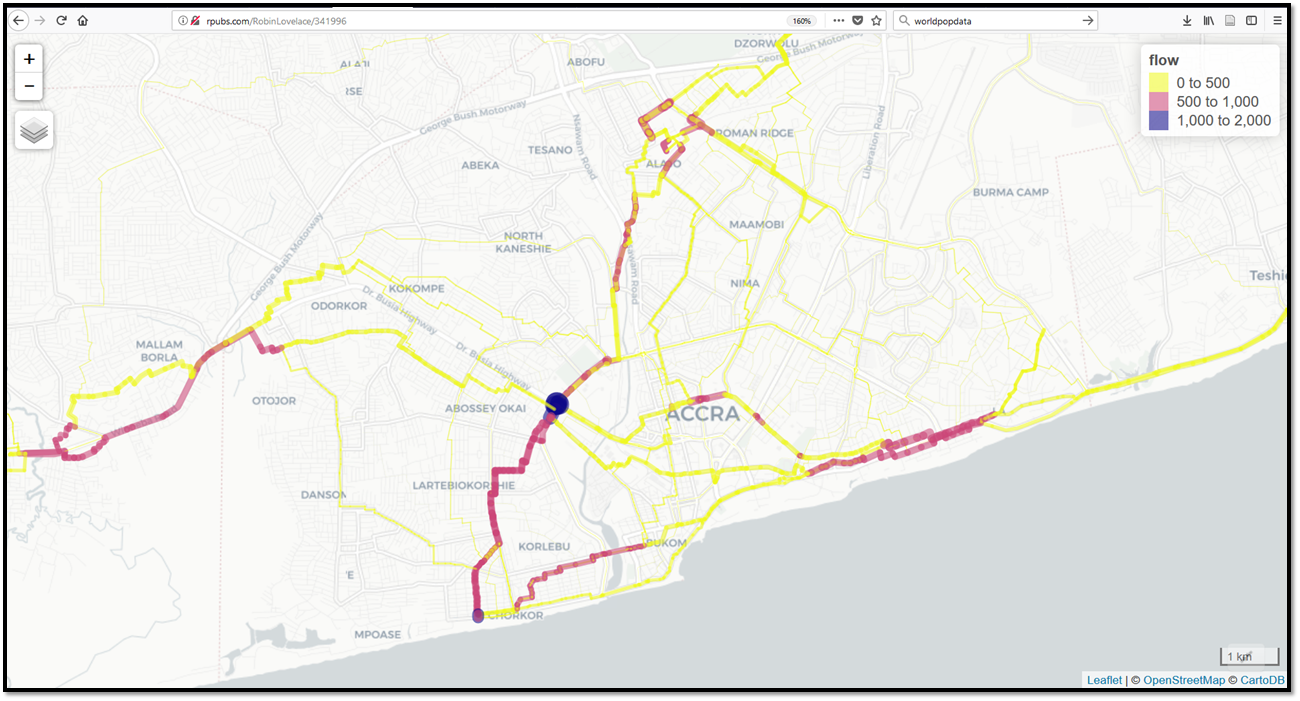
  • World Health Organisation (WHO) funded project to explore cycling and walking
knitr::include_graphics("https://raw.githubusercontent.com/ATFutures/who/master/fig/accra-flow1-interactive.png")

Demo of Active Transport Toolkit in Accra

Demo of PCT approach in Minnesota

Data source: gisdata.mn.gov

Next steps

  • Phase III PCT: Schools layer, training, 'near market' scenario
  • Phase II of CyIPT: research phase -> make publicly accessible
  • Creating an active transport toolkit for cities internationally
  • Must be a conversation

Links + references