- Introduction: the Propensity to Cycle Tool
- The impacts of transport infrastructure
- Methods
- Results and discussion
Source code: github.com/npct/pct/ 2017-08-24
Contents
Introduction
The Propensity to Cycle Tool - see www.pct.bike

The front page of the open source, open access Propensity to Cycle Tool (PCT).
Prior work (source: Lovelace et al. 2017)
| Tool | Scale | Coverage | Public access | Format of output | Levels of analysis | Software licence |
|---|---|---|---|---|---|---|
| Propensity to Cycle Tool | National | England | Yes | Online map | A, OD, R, RN | Open source |
| Prioritization Index | City | Montreal | No | GIS-based | P, A, R | Proprietary |
| PAT | Local | Parts of Dublin | No | GIS-based | A, OD, R | Proprietary |
| Usage intensity index | City | Belo Horizonte | No | GIS-based | A, OD, R, I | Proprietary |
| Bicycle share model | National | England, Wales | No | Static | A, R | Unknown |
| Cycling Potential Tool | City | London | No | Static | A, I | Unknown |
| Santa Monica model | City | Santa Monica | No | Static | P, OD, A | Unknown |
The PCT team
"If you want to go far, go as a team"
Robin Lovelace (Lead Developer, University of Leeds)
- James Woodcock (Principal Investigator, Cambridge University)
- Anna Goodman (Lead Data Analyst, LSHTM)
- Rachel Aldred (Lead Policy and Practice, Westminster University)
- Ali Abbas (User Interface, University of Cambridge)
- Alvaro Ullrich (Data Management, University of Cambridge)
- Nikolai Berkoff (System Architecture, Independent Developer)
- Malcolm Morgan (GIS and infrastructure expert, UoL)
Policy feedback
"The PCT is a brilliant example of using Big Data to better plan infrastructure investment. It will allow us to have more confidence that new schemes are built in places and along travel corridors where there is high latent demand."
- Shane Snow: Head of Seamless Travel Team, Sustainable and Acessible Travel Division
"The PCT shows the country’s great potential to get on their bikes, highlights the areas of highest possible growth and will be a useful innovation for local authorities to get the greatest bang for their buck from cycling investments and realise cycling potential."
- Andrew Jones, Parliamentary Under Secretary of State for Transport
The PCT in CWIS and LCWIP
Included in Cycling and Walking Infrastructure Strategy (CWIS) and the Local Cycling and Walking Infrastructure Plan (LCWIP)

How the PCT works
Shows on the map where there is high cycling potential, for 4 scenarios of change
- Government Target
- Gender Equality
- Go Dutch
- Ebikes
Scenario shift in desire lines
Source: Lovelace et al. (2017)

- Origin-destination data shows 'desire lines'
- How will these shift with cycling uptake
Scenario shift in network load

The impacts of transport infrastructure
The impacts of transport infrastructre
Credit: flickr user thestuff, Creative Commons Licence

Research into impacts of roads
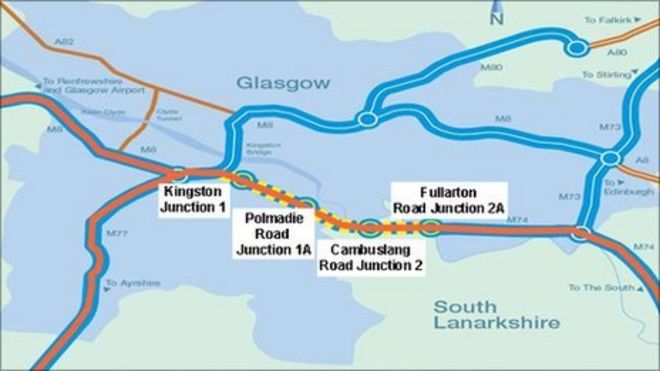
The extension of the M74 motorway = 'natural experiment':
- People who live near motorways seem to be less physically active (D. Ogilvie et al. 2006)
- And more car dependent (Prins et al. 2017)
- Although no evidence of impacts on active travel
Research into impacts of roads II
A recent review of impact assessment methods in the English context found that an increasingly wide range of methods and approaches were being used (Tajima and Fischer 2013):
- Environmental Impact Assessment (EIA)
- Strategic Environmental Assessment (SEA)
- Health Impact Assessment (HIA)
- Gender Impact Assessment (GIA)
Equality Impact Assessment (EqIA)
But overall not a huge amount of research in the area, particularly in relation to the impact on active travel:
- "there is very little empirical data on the impact of road transport interventions", aside from injury reduction estimates (Thomson et al. 2008)
Active travel impacts: a typology

A typology of active travel options.
Methods
The study area
Parallels (Credit: Philip McErlean, CC )

Cycling potential parallel to the route
3 stage methodology to identify parallel lines:
- Subset desire lines whose cetrepoints are far from the proposed route
- Segment the proposed route
- Calculate the angle of each route
Then keep only lines parallel to proposed route segments