12/10/2016
Testes de hipótese: noções gerais
Testes de hipótese
- Teste estatístico sobre a relação entre conjuntos de variáveis
- Ex.: qual a relação entre as alturas de homens e mulheres?
- Confronta duas hipóteses sobre a variável
- H0, hipótese nula: as diferenças observadas entre as variáveis são devidas ao acaso, coincidência
- Ha, hipótese alternativa: as diferenças observadas são influenciadas por alguma causa não-aleatórias
Testes de hipótese
- O resultado do teste é o p-valor, i.e., a probabilidade de o resultado observado caso H0 seja verdadeira – P(resultado|H0)
- Se p-valor < alfa, rejeitamos H0
- Se p-valor >= alfa, não há evidências para rejeitar H0
- O valor alfa é o nível de significância do teste; é comum usar 0.05 (5%).
Testes de hipótese: exemplo
- Uma moeda é lançada 30 vezes e resulta em 22 caras. A moeda é justa?
- Formulação das hipóteses:
- H0: a moeda é justa, i.e., P(cara) = P(coroa) = 0.5
- Ha: a moeda é enviesada, i.e., P(cara) ≠ P(coroa)
- p-valor = P(22 caras | moeda justa)
- Nesse caso, p = 0.01762 (pode ser calculado com base em regras de probabilidade)
- Rejeitamos a hipótese nula, e concluímos que há evidências significativas de que a moeda é enviesada
Testes de hipótese: exemplo em R
prop.test(22, 30)
##
##  1-sample proportions test with continuity correction
##
## data:  22 out of 30, null probability 0.5
## X-squared = 5.6333, df = 1, p-value = 0.01762
## alternative hypothesis: true p is not equal to 0.5
## 95 percent confidence interval:
##  0.5382722 0.8702456
## sample estimates:
##         p
## 0.7333333
Testes de hipótese: o que não dizer
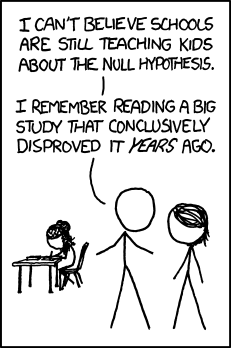
- Exemplo: P(22 caras | moeda justa) = 0.01762
- "Há 1.76% de chance de a moeda ser justa"
- Por que essa afirmação é imprecisa?
xkcd
Erros de decisão
Os testes eventualmente podem levar a conclusões erradas:
- Erro tipo I: rejeitar H0 quando ela é verdadeira.
- P(erro tipo I) = alfa
- Erro tipo II: não rejeitar H0 quando ela é falsa.
- P(erro tipo II) é chamado de beta
Poder do teste
- Normalmente se deseja rejeitar H0
- Isso significa encontrar evidências de que sua hipótese sobre uma relação entre variáveis é verdadeira
- Por isso, buscamos usar o teste estatístico com maior poder que pudermos usar
Teste T
Escolha de testes de hipótese
- Cada teste serve para um tipo de hipótese
- Cada teste é adequado para certos tipos de variáveis (categóricas, numéricas…)
- Cada teste possui pressupostos (assumptions) que devem ser atendidos
- Do contrário, o p-valor não tem significado
Teste de t-Student (teste T) para 2 amostras independentes
- Avalia a hipótese alternativa de que duas populações possuem médias diferentes
- Pressupostos:
- Independência: os dados de uma amostra são independentes dos dados da outra
- Normalidade: as duas populações seguem distribuições normais
- Homocedasticidade: as duas populações possuem a mesma variância (desvio-padrão^2)
- O teste T é robusto a desvios pequenos e médios dos pressupostos
Teste T: exemplo em R
masc <- survey %>% filter(Sex == 'Male')
fem <- survey %>% filter(Sex == 'Female')

# OBS.: conf.level = 1 - alfa. O padrão é 0.95
t.test(masc$Height, fem$Height, conf.level = 0.95)
##
##  Welch Two Sample t-test
##
## data:  masc$Height and fem$Height
## t = 12.924, df = 192.7, p-value < 2.2e-16
## alternative hypothesis: true difference in means is not equal to 0
## 95 percent confidence interval:
##  11.13420 15.14454
## sample estimates:
## mean of x mean of y
##  178.8260  165.6867
Teste T: exemplo em R (outra forma)
Teste T pode ser pensado como uma hipótese sobre a relação entre uma variável numérica e uma variável binária (categórica com 2 valores possíveis):
t.test(survey$Height ~ survey$Sex)
##
##  Welch Two Sample t-test
##
## data:  survey$Height by survey$Sex
## t = -12.924, df = 192.7, p-value < 2.2e-16
## alternative hypothesis: true difference in means is not equal to 0
## 95 percent confidence interval:
##  -15.14454 -11.13420
## sample estimates:
## mean in group Female   mean in group Male
##             165.6867             178.8260
Teste T: exemplo em R (considerações)
- Note que esse estudo possui uma ameaça à validade externa (generalização das conclusões):
- Os dados são de estudantes de estatística da Universidade de Adelaide, Australia (veja no R:
?MASS::survey) - A amostra estudada não é uma amostra aleatória de toda a população mundial
- Os dados são de estudantes de estatística da Universidade de Adelaide, Australia (veja no R:
Teste T: avaliando os pressupostos
- Independência: é uma consequência da forma como os dados foram obtidos
- Normalidade: pode ser avaliado usando testes de normalidade como
shapiro.testeks.test(ou graficamente com um histograma ou um Q-Q plot) - Homocedasticidade: pode ser avaliado usando testes de variância como o
var.test(ou graficamente com um Q-Q plot)
Teste T: avaliando normalidade
H0: população possui distribuição normal
shapiro.test(masc$Height)
##
##  Shapiro-Wilk normality test
##
## data:  masc$Height
## W = 0.99175, p-value = 0.7719
shapiro.test(fem$Height)
##
##  Shapiro-Wilk normality test
##
## data:  fem$Height
## W = 0.98027, p-value = 0.1313
Teste T: avaliando normalidade
hist(masc$Height)

Teste T: avaliando normalidade
hist(fem$Height)

Teste T: avaliando normalidade
qqnorm(masc$Height)
qqline(masc$Height)

Teste T: avaliando normalidade
qqnorm(fem$Height)
qqline(fem$Height)

Teste T: avaliando homocedasticidade
var.test(masc$Height, fem$Height)
##
##  F test to compare two variances
##
## data:  masc$Height and fem$Height
## F = 1.8557, num df = 105, denom df = 101, p-value = 0.001951
## alternative hypothesis: true ratio of variances is not equal to 1
## 95 percent confidence interval:
##  1.257430 2.734627
## sample estimates:
## ratio of variances
##           1.855722
Teste T: avaliando homocedasticidade
- Os dados são heterocedásticos!
- Não tem problema; nesse caso a função
t.testdo R usa o teste T de Welch- adaptação do teste t-Student que lida com o problema da heterocedasticidade
Teste T: avaliando homocedasticidade
Note a linha: "Welch Two Sample t-test"
t.test(survey$Height ~ survey$Sex)
##
##  Welch Two Sample t-test
##
## data:  survey$Height by survey$Sex
## t = -12.924, df = 192.7, p-value < 2.2e-16
## alternative hypothesis: true difference in means is not equal to 0
## 95 percent confidence interval:
##  -15.14454 -11.13420
## sample estimates:
## mean in group Female   mean in group Male
##             165.6867             178.8260
Teste T: avaliando pressupostos (dica)
- Em um artigo, você não precisa mostrar todos esses gráficos e análises para justificar o uso do teste T
- Simplesmente diga que verificou o pressuposto de normalidade com o teste (insira aqui o nome do teste que você usou)
Teste T pareado
- Igual ao teste T, só que para duas amostras dependentes
- duas amostras de mesmo tamanho, cada valor em uma amostra está relacionado ao valor na outra
- ex.: medir o desempenho de uma pessoa usando a ferramenta X e usando a ferramenta Y
- Hipóteses:
- H0: a diferença (xi - yi) tem média 0
- Ha: a diferença é diferente de 0
Teste T pareado
- Pressupostos:
- Dependência: os dados são pareados
- Normalidade: a diferença entre as variáveis segue uma distribuição normal
Teste T pareado: checando normalidade
Exemplo: a mão que escreve (Wr.Hnd) e a outra mão (NW.Hnd) possuem tamanhos diferentes, medidos da ponta do polegar à ponta do dedo mínimo?
Teste T pareado: checando normalidade
hist(survey$Wr.Hnd - survey$NW.Hnd)

Teste T pareado: checando normalidade
shapiro.test(survey$Wr.Hnd - survey$NW.Hnd)
##
##  Shapiro-Wilk normality test
##
## data:  survey$Wr.Hnd - survey$NW.Hnd
## W = 0.8757, p-value = 5.786e-13
Teste T pareado: exemplo em R
A mão que escreve (Wr.Hnd) e a outra mão (NW.Hnd) possuem tamanhos diferentes, medidos da ponta do polegar à ponta do dedo mínimo?
Teste T pareado: exemplo em R
(OBS.: nesse caso não devemos usar o teste T pois não atendemos ao pressuposto de normalidade!)
t.test(survey$Wr.Hnd, survey$NW.Hnd, paired=TRUE)
##
##  Paired t-test
##
## data:  survey$Wr.Hnd and survey$NW.Hnd
## t = 2.1268, df = 235, p-value = 0.03448
## alternative hypothesis: true difference in means is not equal to 0
## 95 percent confidence interval:
##  0.006367389 0.166513967
## sample estimates:
## mean of the differences
##              0.08644068
Testes não-paramétricos
Paramétrico vs não-paramétrico
- O teste T é um teste paramétrico, pois assume que os dados seguem uma determinada distribuição
- E se esse pressuposto não puder ser atendido?
- Podemos usar testes não-paramétricos
Teste Mann-Whitney
- Equivalente ao teste T para duas amostras independentes
- Compara as medianas de duas amostras (mais ou menos)
- Pressupostos:
- As duas amostras são independentes
- A variável estudada é no mínimo ordinal
- As duas amostras possuem a mesma forma (ver discussão detalhada)
Teste Mann-Whitney: exemplo em R
Número de testes executados é diferente comparando projetos em Java e em Ruby?
Teste Mann-Whitney: exemplo em R
boxplot(builds100$tr_tests_run ~ builds100$gh_lang)

Teste Mann-Whitney: exemplo em R
wilcox.test(builds100$tr_tests_run ~ builds100$gh_lang)
## Warning in wilcox.test.default(x = c(0L, 3L, 1148L, 136L, 179L, 147L), y =
## c(718L, : cannot compute exact p-value with ties
##
##  Wilcoxon rank sum test with continuity correction
##
## data:  builds100$tr_tests_run by builds100$gh_lang
## W = 68, p-value = 0.09294
## alternative hypothesis: true location shift is not equal to 0
Teste de Wilcoxon pareado
- Similar ao teste de Mann-Whitney, para dados pareados
- Análogo ao teste T pareado, porém não paramétrico
Teste de Wilcoxon: exemplo em R
Existe diferença entre o número de arquivos adicionados e o número de arquivos removidos em cada build?
Teste de Wilcoxon: exemplo em R
boxplot(1+builds100$gh_files_added, 1+builds100$gh_files_modified, log="y")

Teste de Wilcoxon: exemplo em R
wilcox.test(builds100$gh_files_added, builds100$gh_files_modified, paired=T)
##
##  Wilcoxon signed rank test with continuity correction
##
## data:  builds100$gh_files_added and builds100$gh_files_modified
## V = 105.5, p-value = 7.472e-16
## alternative hypothesis: true location shift is not equal to 0
Sumário: testes para duas amostras, variáveis numéricas
Testes
| paramétrico | não-paramétrico | |
|---|---|---|
| independentes | Teste T | Teste U (Mann-Whitney) |
| pareados | Teste T pareado | Teste de Wilcoxon pareado |
Observações:
- nos testes não paramétricos, as variáveis podem ser ordinais
- quando podem ser aplicados, os testes paramétricos geralmente possuem poder maior que os não-paramétricos
Funções em R
| paramétrico | não-paramétrico | |
|---|---|---|
| independentes | t.test(...) |
wilcox.test(...) |
| pareados | t.test(..., paired=T) |
wilcox.test(..., paired=T) |
Tópicos avançados sobre teste de hipótese
Múltiplos testes
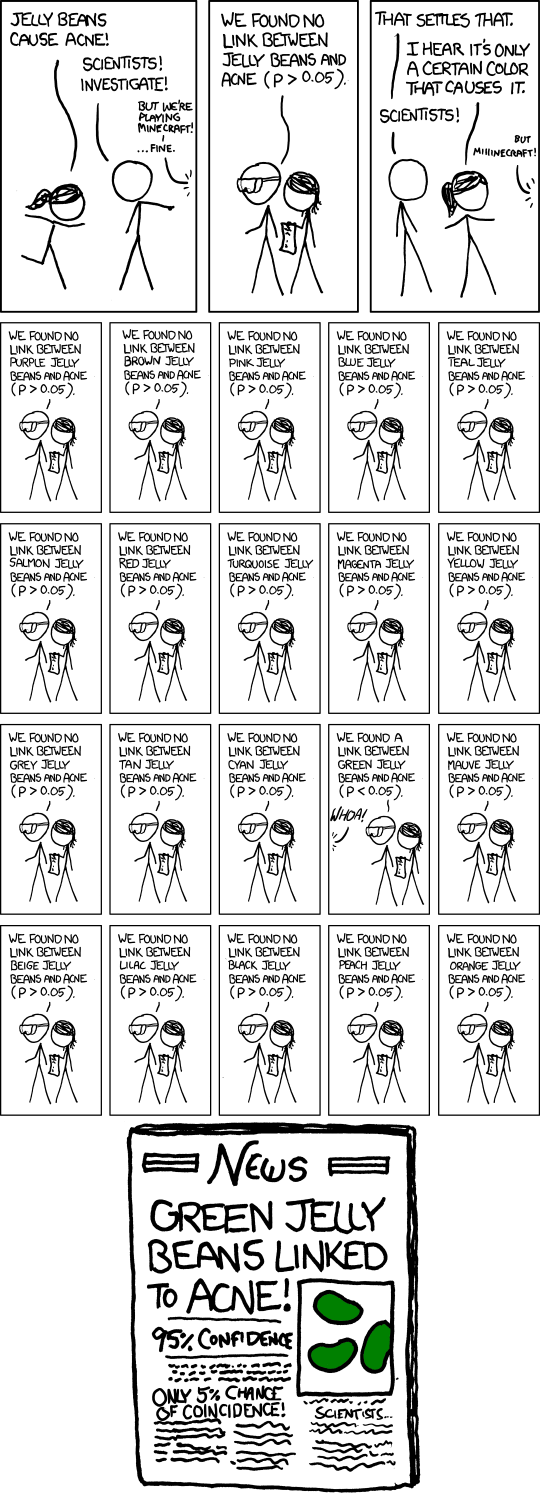
- Você quer avaliar se a moeda usada na Copa do Mundo de 2014 é enviesada através de um experimento: lança a moeda 30 vezes e conta número de caras.
- Com um lançamento, não foi possível rejeitar H0.
- Você repete o experimento 100 vezes, até que finalmente o resultado é 22 caras (p < 0.05).
- Você escreve um artigo dizendo que provou que a moeda da copa é enviesada.
- O que está errado?
xkcd
Correção de Bonferroni
- No caso de múltiplos testes de hipótese, deve ser aplicado um fator de correção ao alfa (para rejeitar H0, p < alfa * fator)
- O método de correção mais simples é a correção de Bonferroni, na qual fator = 1 / n, onde n é o número de repetições
- Assim, se vamos considerar alfa = 5% e realizar 10 repetições, então só rejeitamos H0 se p < 0,5%
- A correção de Bonferroni é muito conservadora (existem outras)
- i.e., diminui o poder do teste
- i.e., fica mais difícil rejeitar H0
p-hacking
Tamanho do efeito e relevância
Resultado estatisticamente significativo nem sempre é significativo:
- A diferença observada pode ser muito pequena
- Ex.: A diferença de tempo entre P1 e P2 é de 1 segundo, em média.
- O resultado pode não ter implicações práticas ou teóricas interessantes
- O tamanho do efeito pode ser calculado com o Delta de Cliff (ver pacote
compute.esdo R)
Variáveis de confusão
- Uso de protetor solar está causa câncer de pele?
- Significância estatística ≠ causa
- Exposição ao sol está associado tanto com uso de protetor solar quanto à incidência de câncer de pele
- Exposição ao sol é uma variável de confusão
Testes para mais de duas amostras
Discussão sobre número de amostras
- Até agora, estudamos testes para comparar duas amostras
- i.e., uma variável numérica vs. uma variável binária
- i.e., consideramos um fator com dois tratamentos
- ex.: fator linguagem de programação, tratamentos Java e Ruby
- E se quisermos comparar três amostras?
- ex.: fator linguagem de programação, tratamentos Java, Ruby e Python
- Solução 1: comparar as amostras duas a duas
- Problema: múltiplos testes
ANOVA
- ANOVA (ANalysis Of VAriance) é um teste para comparar mais de duas amostras
- Tipos:
- 1-way ANOVA: um fator com 3 ou mais tratamentos (ex.: linguagem = Java, Ruby ou Python)
- 2-way ANOVA: dois fatores (ex.: linguagem = Java ou Ruby, tamanho da equipe = pequeno ou grande – nesse caso são quatro amostras)
- n-way ANOVA: n fatores
1-way ANOVA
- Hipóteses:
- H0: todas as amostras possuem a mesma média para a variável analisada
- Ha: pelo menos uma das amostras possui média diferente
- Pressupostos: normalidade, homocedasticidade, independência (como no teste T)
1-way ANOVA: exemplo em R
A taxa de batimentos cardíacos depende da frequência de exercício dos alunos (frequente, algum, nenhum)?
summary(aov(survey$Pulse ~ survey$Exer))
##              Df Sum Sq Mean Sq F value Pr(>F)
## survey$Exer   2    900   450.2   3.378 0.0362 *
## Residuals   189  25188   133.3
## ---
## Signif. codes:  0 '***' 0.001 '**' 0.01 '*' 0.05 '.' 0.1 ' ' 1
## 45 observations deleted due to missingness
2-way ANOVA e n-way ANOVA
Alternativas não-paramétricas ao ANOVA
- Kruskall-Wallis (1-way)
- Friedman (2-way, unreplicated complete block design)
Testes de hipótese para números: resumo
Resumo
- Para duas amostras:
- paramétrico: teste T (pareado ou não)
- não-paramétrico: Wilcoxon (pareado ou não)
- Para mais de duas amostras:
- paramétrico: ANOVA (1-way, 2-way ou n-way)
- não-paramétrico: Kruskall-Wallis (1-way) ou Friedman (2-way)
Testes para variáveis nominais
Exemplo de dados nominais
Considere os bugs de um projeto de software, que podem ser classificados quanto à severidade (severo ou não-severo) e prioridade (prioritário e não-prioritário). Podemos sumarizar os dados através de uma tabela de contingência 2x2:
bugs2 <- bugs %>% mutate(prioritario = priority %in% c('P1', 'P2'),
         severo = severity %in% c('blocker', 'critical', 'major'))
tab <- xtabs(~ prioritario + severo, data=bugs2)
tab
##            severo
## prioritario FALSE  TRUE
##       FALSE  3471 16908
##       TRUE    511  6529
Exemplo de dados nominais
As duas variáveis (severidade e prioridade) são nomais. Será que elas são independentes? Podemos visualizar com um mosaic plot:
mosaicplot(tab, shade=T)

Teste de independência com qui-quadrado
- O teste do qui-quadrado (chi-squared) pode ser usado para determinar se duas variáveis nominais são independentes ou, equivalentemente, se eles seguem a mesma distribuição
- Pressupostos:
- Menos de 20% das células da tabela de contingência possuem valor < 5.
- Os dados não são pareados
Qui-quadrado: exemplo em R
A distribuição dos status das builds depende da linguagem de programação? Status = canceled, errored, failed, passed ou started; linguagem = Java ou Ruby.
tab <- xtabs(~ gh_lang + tr_status, data=builds)
tab
##        tr_status
## gh_lang canceled errored failed passed started
##    java       78    3197   4191  17733       2
##    ruby      885   11114  17732  74831       0
Qui-quadrado: exemplo em R
A distribuição dos status das builds depende da linguagem de programação? Status = canceled, errored, failed, passed ou started; linguagem = Java ou Ruby.
tab <- xtabs(~ gh_lang + tr_status, data=builds)
chisq.test(tab)
## Warning in chisq.test(tab): Chi-squared approximation may be incorrect
##
##  Pearson's Chi-squared test
##
## data:  tab
## X-squared = 170.46, df = 4, p-value < 2.2e-16
Teste de McNemar
- Versão do qui-quadrado para testes pareados
Teste de McNemar: exemplo em R
Existe dependência entre as variáveis binárias prioridade e severidade em bugs?
tab <- xtabs(~ prioritario + severo, data=bugs2)
chisq.test(tab)
##
##  Pearson's Chi-squared test with Yates' continuity correction
##
## data:  tab
## X-squared = 401.86, df = 1, p-value < 2.2e-16
Tamanho do efeito
- Pode ser medido com o V de Cramer.
Sumário
Sumário
- Os testes de hipótese relacionam uma variável numérica ou categórica com uma variável categórica usada para agrupar os dados.
- Ex.: teste T é variável numérica vs. categórica
- Ex.: teste qui-quadrado é variável categórica vs. categórica
- E se quisermos relacionar duas variáveis numéricas?
- Devemos usar correlação e análise de regressão
Sumário
https://marcoarmello.wordpress.com/2012/05/17/qualteste/
