Race Against Time

Gurpreet Singh
May 13, 2016

Fire Department Response Times

  • Response Time is the key factor in evaluating the performance of Fire Departments
  • There are a number of factors that affect the response times for an emergency
  • Response time is divided into dispatch time, turn out time and travel time
  • We will focus on the travel time for this project that is when the units are notified by dispatchers and time taken by first company to reach the fire location.
  • This project provides provide an in-depth comparative analysis of response times

Research Questions

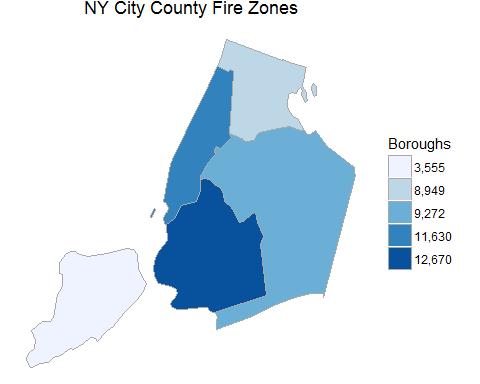
  • Can the boroughs be divided into high, moderate and low risk fire zones based on the incident counts
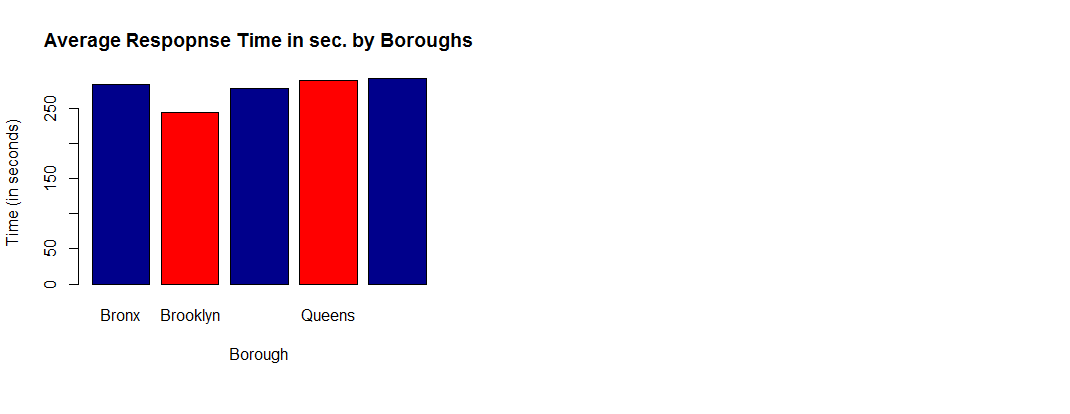
  • Is the average response time in all the boroughs equal
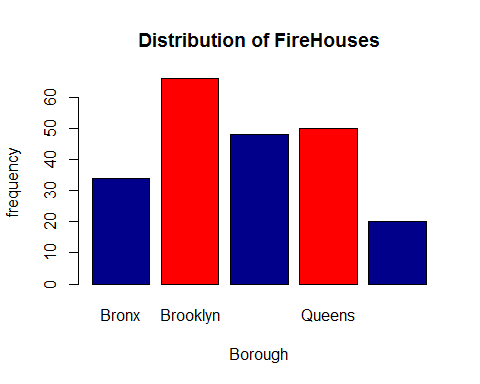
  • All the fire houses locations distributed evenly in the boroughs
  • Does the average response time varies with the number of incidents that is if the ocuurence of fire more more often in a specific area increases ( or decrease) the response time during an emergency

Data Collection

  • Data is gleaned from NYC open Data Community portal Socrata.
  • Datasets response times and locations are used
  • New York Times web api is used to fetch articles related to response times
  • New York State webpage is used to get data for 5 borough's area

Challenges:

  • Line of duty deaths dataset was not updated properly to perform analysis.
  • The response time data has not proper description of fields.
  • The package choroplethr was a challenge, I was not able to highlight the counties with different colors while defining them as high, medium or low risk zones.

Analysis

  • The response dataset consists of structural fires, non-structural fires, medical emergencies, false alarms
    and all fire emergencies. We will analyze all fire emergencies/incident counts.
  • The boroughs were divided into three zones based on incident counts
  • High > 9,000
  • Moderate 5,000 - 9,000
  • Low < 5,000
  • The incident counts consistently reflected Brooklyn, Manhattan as High, Queens, Bronx as moderate and SI as low risk zone
  • Average response time for High zone was 266 seconds, Moderate zone 286 seconds and low zone 291 seconds.
  • The location dataset was converted into a frequency table providing count of the fire houses in boroughs
  • After performing required data manipulation the output of the location dataset and area of counties
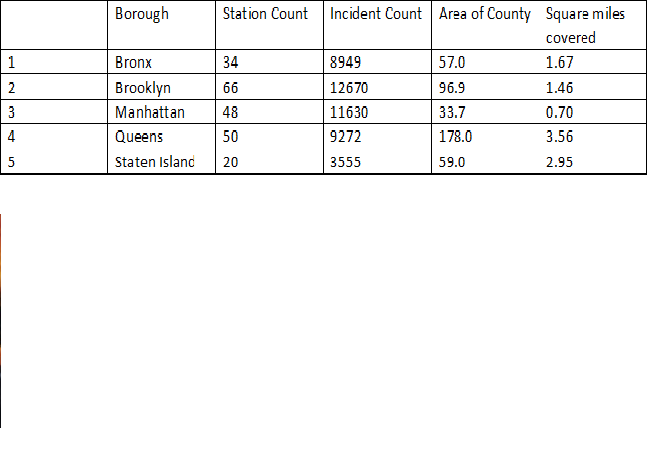
    The locations were unevenly distributed and area covered by each unit varied a lot in each borough.

  • Chi square test was performed to check the dependence of incident count on response times which did not provide strong evidence for dependence of response times on incident counts

  • Corelation coefficient was calculated to determine the if there were some factors affecting response time, station count was negatively corelated to response time with a coffecient of -0.79. that is if one increase other should decrease.

Visualization

Mean Time for three zones
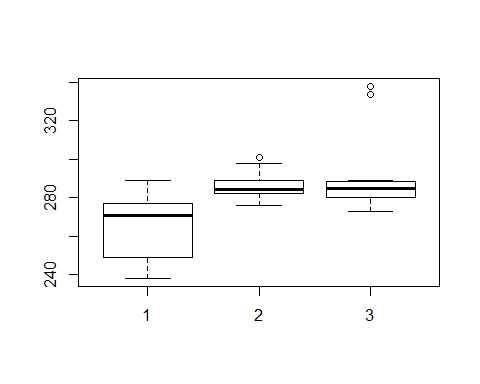
  • 1 = High Risk zone, 2 = Medium Risk, 3 = Low Risk

Distribution of firehouses within five boroughs
Response time within three boroughs
Fire zones based on the incident counts
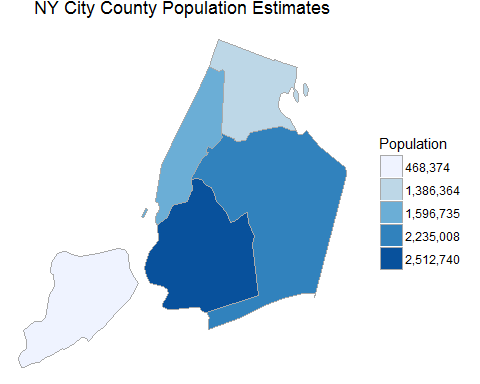
Distribution of Population among five boroughs
Conclusion

  • The boroughs were divided into high, moderate and low risk zones
  • Based on the incident counts Brooklyn and Manhattan were classified as High Risk zones, Queens and Bronx were moderate risk and Staten Island as low risk fire zone.
  • Location of firehouses was an important factor in determining response time. The area covered per square mile by each firehouse varied differently. It was discovered that Si has more square miles coverage per fire house as compared to other boroughs.
  • Stations in Manhattan and Brooklyn were shortest distance apart as compared to Queens and SI.
  • In addition the no. of firehouses were distibuted unevenly in different boroughs.

Further Exploration

  • This study can be a step towards analyzing the response time.
  • Indepth analysis of fire incidents breaking them into different categories, accessing the traffic data in different boroughs, high rise buildings can provide more useful insights in the study.
  • Response time for structural fires can be different from false alarms and medical emergencies.
  • Average square mile covered per minute can be different in all the boroughs, red lights and various other factors can be considered.

-The link to the project

Refrences: