Primary Sources
In Class: In groups, compare Madison’s “A Candid State of Parties” with Federalist No. 10. What are the key differences between the two pieces?
Duration: 1 week · 3 days
Reading Questions 1. According to Hofstadter, what was the Founding Fathers’ fundamental view of human nature, and how did this perspective shape their approach to designing the Constitution? 2. How did the Founding Fathers understand the problem of factions, and what constitutional mechanisms did they design to control factional conflict? 3. What did the Founding Fathers mean by “liberty,” and how was this concept connected to property ownership rather than democracy?
Primary Source: Federalist No. 10, Excerpts
Reading Questions 1. According to Reichley, why did the Founding Fathers oppose political parties, and how did this opposition relate to their broader vision of republican government? 2. How did James Madison’s analysis of faction in Federalist No. 10 and No. 51 inform the constitutional structure designed to control factional conflict? 3. What were the divisions between conservative and populist factions in the state governments during the 1780s? What were the key policy disagreements between these groups, what geographic and social bases did each faction draw upon, and how did these conflicts shape the Founders’ approach to designing the Constitution?
Reading Questions 1. What were the main components of Hamilton’s financial program, and why did they provoke such strong sectional opposition? 2. How did Madison’s views on political parties evolve between the ratification debates and 1792, as evidenced in his essay “A Candid State of Parties”? 3. According to the chapter, what strategies did Jefferson and Madison employ to oppose Hamilton’s policies while avoiding being labeled as Antifederalists or sectional particularists?
In Class: In groups, compare Madison’s “A Candid State of Parties” with Federalist No. 10. What are the key differences between the two pieces?
Create a Google Slides diagram tracking the developments that led to the formation of a political opposition.
Duration: 2 weeks · 5 days
Reading Questions 1. What were the main components of Hamilton’s economic program, and why did they provoke opposition? 2. How did the French Revolution influence the development of American political parties in the 1790s? 3. Compare and contrast the campaign strategies used by Federalists and Republicans in the election of 1800. 4. According to Reichley, why did the Federalist Party ultimately fail as a governing party despite its early successes?
Reading Questions 1. What specific policies did the early federal government adopt to support newspaper circulation, and how did these policies shape the structure of the American press? 2. What was John Fenno’s original plan for the Gazette of the United States, and how did financial pressures force him to abandon key elements of this plan? What does his experience reveal about the economic realities of early American newspaper publishing? 3. Describe the circumstances and motivations behind Jefferson and Madison’s decision to establish the National Gazette. Why did they choose Philip Freneau as editor, and what assistance did they provide to launch the newspaper? 4. How did Freneau’s National Gazette go beyond simply criticizing government policies to actually help create an opposition party?
In Class: Divide into two groups and write a Federalist or Republican editorial on the Virginia and Kentucky Resolutions — by hand. Background: Kentucky and Virginia Resolutions
Reading Questions 1. What role did the New York state legislative election of May 1800 play in the broader presidential contest, and how did Hamilton respond to the Republican victory there? What does Jay’s refusal to act on Hamilton’s proposal suggest about the limits of partisan maneuvering in this period? 2. Sharp contends that the 1800 election should not be understood as a “national political victory” for the Republicans. What evidence does he marshal to support this interpretation, and how does the sectional distribution of electoral votes and congressional gains inform his argument? 3. How did Gabriel’s Conspiracy intersect with the presidential campaign, and what competing interpretations did Federalists and Republicans offer for the attempted slave insurrection?
Reading Questions 1. According to Reichley, what was the central ideological difference between the Federalists and the Jeffersonians? How did this difference manifest in their respective visions for American society and government? 2. Reichley argues that the Jeffersonian Republicans were “far from complete” in their break with the Federalist past. What evidence does he provide for continuity between the two administrations, and how does he explain Jefferson’s departures from his own stated principles (such as the Louisiana Purchase)? 3. How did the constitutional crisis of 1800–1801 get resolved, and what does this episode reveal about the fragility of the new party system? What role did Alexander Hamilton play in the outcome? 4. Reichley describes the period from 1817–1824 as an attempt at “politics without parties.” Why did this experiment fail, and what does the contested election of 1824 suggest about the relationship between party competition and democratic governance in the early republic?
Reading Questions 1. Keyssar argues that the expansion of suffrage in the early nineteenth century was driven by “the convergence of different factors” rather than any single cause. What were the three main socioeconomic and institutional developments he identifies, and how did each contribute to the broadening of the franchise? 2. How did changes in the social structure — particularly the growth of propertyless populations in cities and the increase in farm tenancy — create pressure for suffrage reform? What strategies did disfranchised men use to advocate for their political rights, and why does Keyssar suggest these efforts alone were insufficient to achieve reform? 3. Keyssar discusses the role of partisan competition in expanding suffrage, noting that “the elementary dynamics of electoral competition created a stimulus for reform.” How did competition between political parties (first Federalists vs. Republicans, then Whigs vs. Democrats) lead to broader franchise laws, even when some party leaders may not have supported democratization on ideological grounds? 4. What was “declarant” or “alien intent” suffrage, and why did it become particularly common in the Midwest during the 1840s and 1850s? What does this development reveal about the relationship between immigration, economic development, and voting rights in this period?
Duration: 2–3 weeks · 8 days
Reading Questions 1. How did the Jacksonian Democrats differ from the Federalists and Jeffersonian Republicans in their approach to party organization and patronage? 2. What arguments did Martin Van Buren make in defense of political parties and the two-party system, and how did this represent a departure from the Founders’ views? 3. What was the Bank War, and how did Jackson’s conflict with Nicholas Biddle contribute to the formation of the Whig Party? 4. In what ways did the Whigs combine support for economic development with cultural and moral conservatism, and how did this affect their coalition? 5. Why did the Know-Nothing (American) Party rise so rapidly in the mid-1850s, and what factors led to its equally rapid collapse?
Reading Questions 1. How did wealth and economic activity generally correlate with party affiliation in the antebellum North? What patterns emerge from the evidence presented? 2. What made certain Southern and Western states distinctive in terms of their party divisions? How did the political culture of these states develop differently? 3. What does the anecdote about Jefferson Davis and Varina Howell reveal about typical social and economic alignments within Southern political parties? 4. What economic and social factors shaped party divisions in Northern cities and towns? How did these urban patterns differ from rural areas? 5. How did leading politicians like William Seward and Alexander Hamilton Stephens balance their views on slavery with their partisan commitments? What does this suggest about the role of political parties before 1850?
Reading Questions 1. What role did ethnic, religious, and sectional identifications play in sustaining high voter turnout in the nineteenth century? How did these “tribalist” features shape the nature of political conflict? 2. How did patronage-based “clientelist” party organizations contribute to high levels of voter participation? What resources and methods did these organizations use to mobilize voters? 3. What does Piven and Cloward mean when they argue that nineteenth-century electoral arrangements “produced high levels of participation among the white men who were eligible to vote, but at the same time these methods limited their influence on government”? 4. How did post-Civil War economic transformations strain the earlier methods of political incorporation? What kinds of popular demands began to emerge into electoral politics? 5. Why are Piven and Cloward skeptical of the celebratory depiction of nineteenth-century politics as a “Golden Era” of American democracy? What alternative interpretation do they offer?
Primary Source: The Gold Spoon Speech
Reading Questions 1. Selinger argues that party legitimization in the Jacksonian era was “not as linear or progressive as many have imagined.” What conditions does he identify as necessary for party competition to gain acceptance among political elites, and why were both conditions required? 2. Van Buren argued that reviving “old party attachments” between Jeffersonian Republicans and Federalists was the best antidote to sectional conflict over slavery. What was the logic of this argument, and what institutional mechanisms did Van Buren design to make it work in practice? 3. How did the Nullification Crisis of 1832–33 threaten Van Buren’s coalition-building project, and how did Van Buren respond to Jackson’s more nationalist impulses during the standoff with South Carolina? 4. Selinger claims that “party competition itself” helped unleash the sectional tensions it was designed to contain. Using the example of territorial expansion and the Wilmot Proviso, explain how Democratic Party competition contributed to reopening the slavery question. 5. By 1856, Van Buren reflected that party “neutralizing considerations” had served as the Union’s “balance-wheel.” In what sense does Selinger treat this as both an achievement and a fundamental limitation of the Second Party System?
Primary Source: Van Buren, letter to Ritchie
Reading Questions 1. The Slave Power argument was central to how Liberty and Free Soil partisans justified their third-party strategy. What did this argument claim, and how did it explain why antislavery voters should refuse to support even ostensibly antislavery Whigs or Democrats? 2. The mechanics of antebellum elections differed substantially from today’s system. How did the party ticket system and the absence of state-regulated ballots make cross-endorsement easier to execute? What features of the modern Australian ballot system would have made the fusion strategies described in this article more difficult or impossible? 3. The John P. Hale case is presented as one of the most successful examples of third-party cross-endorsement. Trace the sequence of events from Hale’s break with the Democratic Party in 1845 through his election to the U.S. Senate. What combination of institutional features (such as the majority-vote requirement) and political decisions made this outcome possible? 4. The authors argue that antislavery third parties had to constantly balance principled independence against pragmatic coalition-building. Using at least two specific examples from the article, explain how Liberty or Free Soil leaders navigated this tension. Were there cases where cross-endorsement seemed to compromise third-party integrity? 5. The article connects antebellum history to contemporary debates over fusion voting laws and third-party politics. What do the authors suggest the pre-Civil War experience reveals about the potential role of third parties today?
In Class: Compare the Liberty Party platform with the Free Soil Party platform (1848). What did the Free Soilers give up, ideologically speaking, compared to the Liberty Party? How should we evaluate this decision?
Reading Questions 1. According to Ashworth, what were the main arguments temperance reformers made in favor of Prohibition, and how did these arguments reflect broader anxieties about economic change in the antebellum North? 2. How did the Democratic and Whig parties each respond to the temperance movement, and why did both parties struggle to maintain unity on the issue? 3. What specific grievances drove the rise of the Know Nothing party in the early 1850s, and what policy changes did Know Nothings primarily seek? Why did they focus on naturalization periods rather than simply restricting immigration outright? 4. Ashworth argues that nativists found it difficult to articulate a consistent principle for their discrimination against immigrants. What was this internal contradiction, and what does it reveal about the actual basis of nativist hostility? 5. What ideological similarities does Ashworth identify between the Whig party, temperance reformers, and Know Nothings? What does this suggest about the social vision underlying all three movements?
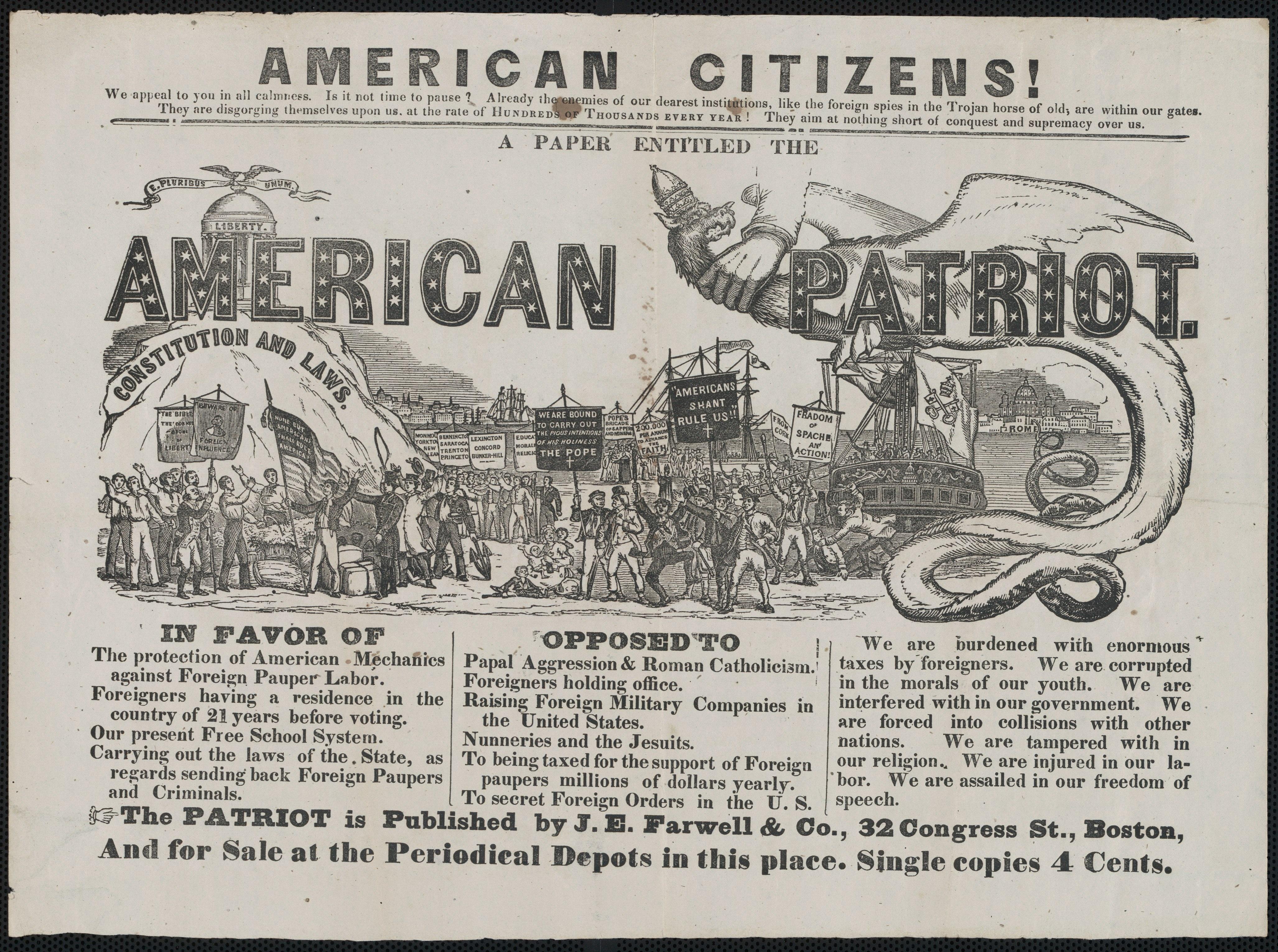
In Class: Comparison of nativism then and now. Primary source: Know Nothing party platform
Reading Questions 1. Ashworth argues that the United States faced a genuine crisis in the early 1850s even though most Americans believed the Compromise of 1850 had resolved it. What was the actual underlying crisis, and why does Ashworth say its invisibility made it more dangerous rather than less? 2. How does Ashworth explain Douglas’s role in advancing the interests of slaveholders through the Kansas-Nebraska Act? Why does he reject the “doughface” interpretation, and what does his alternative explanation reveal about the relationship between Democratic ideology and slavery? 3. What were the multiple reasons southern politicians supported the Kansas-Nebraska Act, and why did they believe they had “nothing to lose and everything to gain”? How does Ashworth ultimately evaluate their reasoning? 4. Ashworth claims that the Kansas-Nebraska Act reflected not the strengths but the weaknesses of slavery. What does he mean by this, and how does the situation in Missouri illustrate his argument?
Primary Source: Cass, Popular Sovereignty (excerpts, handout)
Reading Questions 1. Ashworth identifies several longer-term factors that weakened the Whig party before the Kansas-Nebraska crisis. How did the economic prosperity of the 1850s undermine the Whig economic program, and why does Ashworth describe this as “ironic”? 2. Some historians have argued that because the Know Nothings (rather than the Republicans) were the initial primary beneficiaries of the 1854 upheaval, anti-immigrant sentiment must have been more important than antislavery in driving the political realignment. Why does Ashworth call this a “non sequitur”? What evidence does he offer? 3. Ashworth argues that the slavery question destroyed both the Whig party and the Know Nothing movement through essentially the same mechanism. What was that mechanism, and how did events in Kansas make it inescapable for both organizations? 4. In his discussion of the Pro-Slavery Convention at Lexington, Missouri (1855), Ashworth contends that southern defenders of the “border ruffians” inadvertently revealed the weaknesses of slavery even as they tried to justify its defense. What were these revealing admissions, and how does Ashworth connect them to his broader argument about slavery’s vulnerabilities?
The rise of “popular politics” during the Jacksonian era transformed American political culture through mass mobilization, new campaign techniques, and expanded participation. Assess whether these changes strengthened or weakened the American political system’s capacity to address fundamental conflicts like slavery. Did democratization make sectional compromise more or less achievable?
Duration: 2–3 weeks · 7 days
Reading Questions 1. According to Reichley, why were neither the Democrats nor the Whigs able to withstand the divisive force of the slavery issue in the 1850s? What was it about the Republican Party that made it different in this regard? 2. Reichley argues that the Republican Party was “far from being a single-issue party.” Beyond opposition to slavery, what other commitments and policy positions did the early Republican coalition embrace? 3. How does Reichley characterize Lincoln’s evolving views on race and black political participation over the course of the war? What factors does he identify as driving that evolution? 4. What role does Reichley argue the Republican Party apparatus played in Lincoln’s ability to govern during the Civil War? How does he use Jefferson Davis and the Confederacy as a contrasting case? 5. After Lincoln’s assassination, why did Andrew Johnson’s attempt to build a new political coalition with the Blair faction and conservative Unionists ultimately fail? What does Reichley suggest this episode revealed about the strength of Republican Party loyalties by the mid-1860s?
Reading Questions 1. McKitrick argues that the conventional wisdom about parties and the Civil War rests on two assumptions — one about Lincoln, one about Davis. What are those two assumptions, and what does McKitrick claim is wrong about each of them? 2. McKitrick uses the contrasting cases of Hannibal Hamlin and Alexander Stephens, and of William Seward and Robert Toombs, to illustrate a broader argument about party systems. What does each pair of cases reveal, and what is the general point he is making through them? 3. According to McKitrick, how did the Republican party serve as a mechanism for integrating state and national power during the war?
In Class: Political cartoons from the 1864 election: - Cartoon 1 - Cartoon 2 - Cartoon 3
Reading Questions 1. Sinha uses the term “Black Reconstruction” in a specific way that she distinguishes from how W. E. B. Du Bois and James Allen used it. What does each of the three mean by the term, and what is significant about the differences? 2. The black convention movement is, as Sinha notes, “often overlooked in histories of this period.” What functions did the conventions serve, and how did their character and concerns shift over time — from the immediate postwar years through the 1880s and 1890s? 3. Sinha describes the Reconstruction constitutional conventions as neither instances of “negro domination” nor straightforward triumphs of radical democracy. What were the actual compositions and internal divisions of the conventions, and what kinds of policies did the constitutions they produced put in place? 4. Critics of Reconstruction — including James Pike in The Prostrate State — made arguments about corruption and misgovernment that Sinha treats as historically significant beyond their factual accuracy. What does she say those arguments actually represented, and what was their longer-term significance in American political culture? 5. Sinha closes the chapter by arguing that “Reconstruction failed not because its proponents sacrificed economic rights for political rights… but because it was overthrown.” What evidence does she marshal in the chapter to support this interpretation, and what does she suggest might have been possible had Black Reconstruction not been violently ended?
Primary Source: Godkin, “Socialism in South Carolina”
Reading Questions 1. Reichley describes the Gilded Age as the “golden age of parties.” What specific evidence does he offer — in terms of electoral competition, party organization, and voter behavior — to support that characterization? 2. Reichley contrasts the Tammany model under Tweed with the more disciplined machine John Kelly built afterward. What were the key differences in how each man ran Tammany, and how did Kelly’s approach better serve the Democratic Party’s long-term interests? 3. Reichley argues that it is “a mistake” to think of the Radical Republican bosses as cynical conservatives who abandoned the party’s founding principles. What is his case for this claim, and do you find it convincing given what he also says about their motives and methods? 4. The chapter identifies several overlapping sources of Republican dominance in the North — the Civil War legacy, Protestant religious identity, business ties, and organizational superiority. How does Reichley rank or weight these factors against each other, and what does his argument suggest about which was most fundamental? 5. Compare Reichley’s account of the 1876 Hayes-Tilden dispute with Richardson’s account in West from Appomattox. Where do the two authors agree, and where do they differ in emphasis or interpretation?
Primary Source: Steffens, Shame of the Cities (handout)
Reading Questions 1. Reichley argues that the Greenback Party’s fusion with the Democrats in 1882 contributed to its own decline. What specific event does he point to as the party’s “undoing,” and what rule does he say the Greenbackers violated that sealed their fate? 2. According to Reichley, western farmers who joined the Populist movement were largely Republicans by background. What explains their disillusionment with the Republican Party, and why did they find the Democrats an inadequate alternative? 3. Describe the strategic dilemma facing the Populist Party at its St. Louis convention in 1896. What did they ultimately decide, and what were the arguments on each side? How does Henry Demarest Lloyd’s “cowbird” metaphor capture one view of the outcome? 4. Reichley identifies several distinct groups that voted against Bryan despite his efforts to build a broad coalition. Choose two of these groups and explain the specific reasons — economic, cultural, or both — why Bryan failed to win their support. 5. At the end of the chapter, Reichley argues that the 1896 election ultimately reinforced rather than disrupted the existing two-party system. What structural and historical factors does he offer to explain why the Populists failed where the Republicans of the 1850s had succeeded?
Primary Source: Bryan, “Cross of Gold” speech (handout)
Reading Questions 1. Bloom argues that the merchant-landlord class used race as a political weapon during both the Reconstruction and Populist eras. What specific tactics did they employ against these two threats to their power, and what does the similarity of those tactics reveal about their motivations? 2. According to Bloom, the Populist movement represented a genuine attempt at interracial political coalition-building. What evidence does he provide that Populists made concrete overtures to Black voters, and what factors — both violent and electoral — ultimately defeated this coalition? 3. Bloom challenges the argument that disfranchisement and Jim Crow segregation primarily benefited lower-class whites by eliminating Black economic competition. Using the data on school funding (Tables 2–5) and employment segregation, explain his counter-argument. Who, in his view, were the real beneficiaries of disfranchisement? 4. Bloom describes how disfranchisement measures, though ostensibly targeting Black voters, also drastically reduced white voter participation. Why did the Black-Belt elite accept — and in some cases deliberately engineer — this outcome, and how did it serve their long-term political interests? 5. In his concluding summary, Bloom states that “the foundations for and dynamic of Southern racism as it was confronted by the civil rights movement rested upon the class system of the South.” Based on the chapter as a whole, what does he mean by this claim, and how does it differ from explanations of Southern racism that emphasize white racial attitudes more broadly?
Duration: 1 week · 4 days
Reading Questions 1. Reichley identifies several distinct sources of the progressive movement. What were the main groups or traditions that fed into progressivism, and what did they have in common despite their different goals? 2. How did the progressive movement differ from populism in its diagnosis of American political problems and its proposed remedies? 3. What was Theodore Roosevelt’s approach to reform within the Republican Party, and how did it differ from the approaches of LaFollette and Hiram Johnson? 4. What role did business interests play in the progressive movement, and what does this suggest about the movement’s relationship to capitalism?
Primary Source: Wilson, “What is Progress” (handout)
Reading Questions 1. What obstacles prevented the Populists from building a successful farmer-labor coalition in the 1896 election, and why did urban workers largely reject the Bryan campaign? 2. How did the Republican Party and its corporate allies respond to the Democratic-Populist challenge of 1896, and what does Piven and Cloward argue was the long-term significance of McKinley’s victory? 3. What is Piven and Cloward’s argument about the relationship between Progressive Era reforms and the interests of business? How do they use Hofstadter and Kolko to support this claim? 4. According to Piven and Cloward, what happened to voter turnout between 1896 and 1924, and what connection do they draw between declining turnout and the political agenda of the 1920s?
Reading Questions 1. Piven and Cloward argue that focusing on the election of 1896 as the cause of declining turnout is “misleading.” What explanation do they offer instead, and what evidence do they give that 1896 alone cannot account for the turnout drop? 2. What were the two main sets of institutional changes that Piven and Cloward identify as weakening electoral participation after the late nineteenth century? Briefly describe what each set of changes did. 3. According to the authors, what motivated business elites and upper-class reformers to attack the urban political machines? What were the reformers’ stated reasons, and what do Piven and Cloward suggest were the deeper reasons? 4. How did southern states use legal and procedural mechanisms to disenfranchise Black voters and poor whites after Reconstruction? Give at least two specific examples of the devices they used. 5. What role did voter registration requirements play in depressing turnout, and how did those requirements change over the late nineteenth and early twentieth centuries — specifically, what was the shift from “nonpersonal” to “personal” registration, and why did it matter?
Reading Questions 1. Richardson argues that Wilson’s presidency caused Republicans to abandon their earlier commitment to progressivism. What specific policies of the Wilson administration did Republicans oppose most strongly, and what label did they consistently apply to those policies? 2. How did the 1917 Bolshevik Revolution in Russia change the political landscape for Republicans, and how did they use it against Wilson and the Democrats? 3. What was the Boston police strike of 1919, and how did it launch Calvin Coolidge’s national political career? What did Republicans argue the strike represented? 4. What were Andrew Mellon’s core economic arguments for cutting taxes on wealthy Americans, and what did he actually accomplish as Treasury Secretary during the Harding and Coolidge administrations? 5. Richardson ends the chapter on an ironic note, describing the Republicans’ confidence that they had solved America’s economic problems by 1928. What specific policies did Republicans use to promote business prosperity during the 1920s, and what does Richardson’s closing tone suggest about how she wants readers to evaluate those claims?
Duration: 2 weeks · 8 days
Duration: 2 weeks · 8 days
Documentary: George Wallace
Duration: 1 week · 2 days