The Polarization of American Politics: A Story Through Congressional Voting
2025-11-17
Introduction
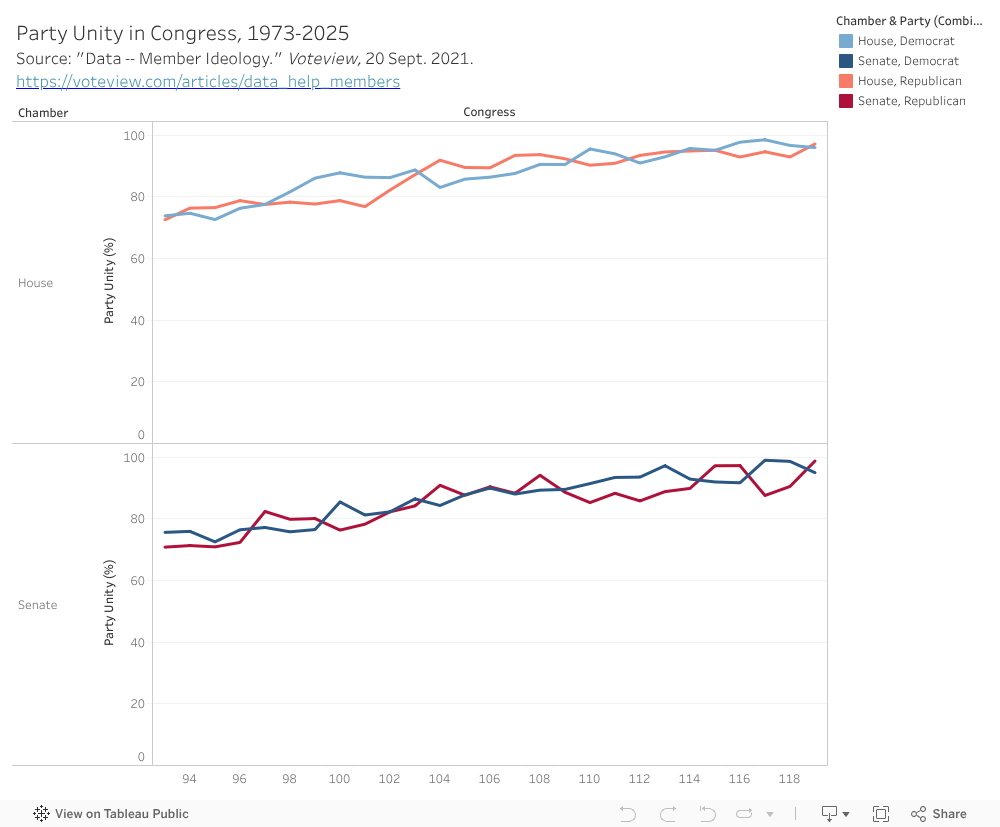
American politics has become increasingly polarized over the past five decades. This analysis explores how Democrats and Republicans in Congress have grown further apart ideologically and how this divide manifests in voting behavior. Using data from the 93rd through 119th Congresses (1973-present), we examine party-unity voting patterns, ideological positioning, and coalition-building across different types of legislation.
Visual 1: Tableau Dashboard - Party Unity Trends Over Time
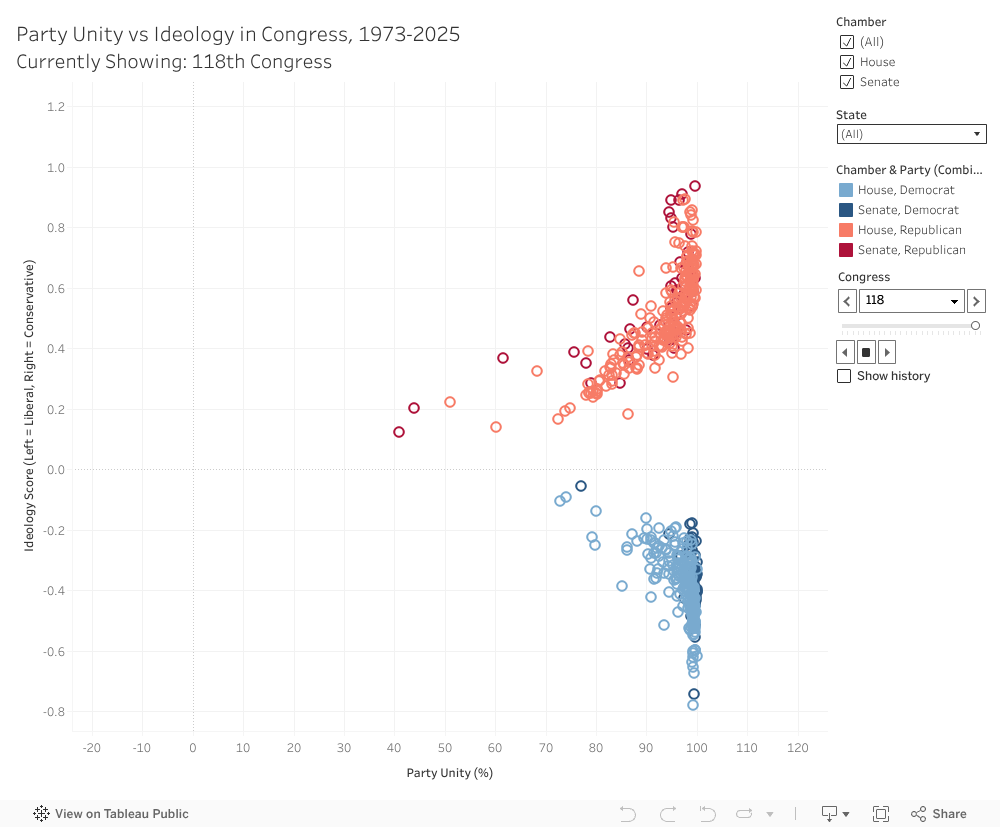
Visual 2: Tableau Dashboard - Individual Member Analysis
Visual 3: Party Overlap Then vs Now

This visualization reveals a striking transformation in American politics. In the 93rd Congress (1973-1975), the ideological distributions of Democrats and Republicans substantially overlapped, with moderate members from both parties occupying the political center. By the 119th Congress, this overlap has nearly vanished, with the parties forming two distinct ideological camps.
Visual 4: Moderates vs Extremes in Party-Line Voting

Members with more extreme ideological positions vote with their party more consistently than moderates in both parties. This pattern reinforces the polarization narrative: not only are the parties more ideologically distinct, but their most ideological members are also their most loyal voters.
Visual 5: How Partisan Are Different Kinds of Votes?

Not all votes are equally partisan. Procedural motions and amendments tend to be the most polarized, while some categories of legislation still see occasional bipartisan cooperation. This suggests that polarization is particularly acute on process-oriented votes that determine which bills reach the floor and how they are debated.
Visual 6: Geographic Polarization by State

Polarization varies significantly by geography. States with larger ideological gaps between their Democratic and Republican delegations (shown in darker blue) demonstrate how regional political cultures contribute to national polarization.
Visual 7: Shiny App - Coalition Explorer
This interactive application allows you to explore individual roll call votes and see how Democrats and Republicans voted on specific pieces of legislation. Select different filters to identify patterns in coalition-building and partisan voting.